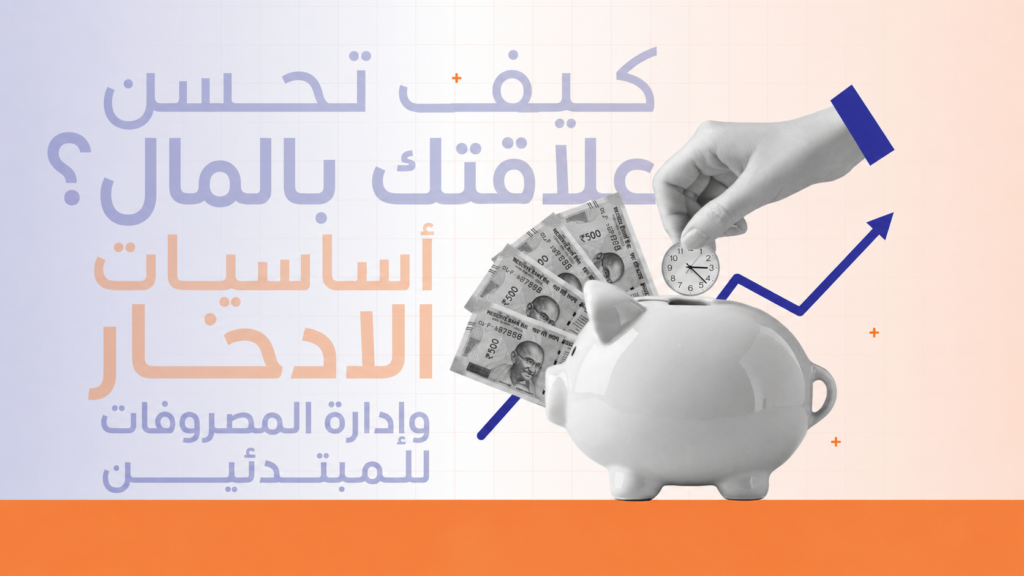
Your relationship with money does not begin with the size of your salary. It begins with what happens when money enters your account, when an unexpected bill appears, when you want to buy something immediately, and when you think about the future. Two people can earn similar incomes and experience very different levels of financial control because their obligations, habits, and planning systems differ.
Improving your relationship with money does not mean becoming extremely restrictive. It means moving from reaction to management. Instead of discovering at the end of the month where the money went, you decide in advance what important jobs the money needs to do.
This article provides general financial education. It is not individualized investment, debt, tax, or legal advice.
The first problem is often lack of visibility
Many beginners focus only on income. They know the salary amount but cannot easily state how much is committed to housing, transportation, subscriptions, debt, food, family responsibilities, and irregular annual expenses. Without visibility, every month feels unpredictable.
Start by reviewing several months of actual transactions. Do not build the budget from what you wish you spent. Use the real numbers first.
Understand your emotional relationship with money
Money can represent security, freedom, status, reward, fear, or self-worth. Those meanings affect behavior. A person who uses spending as a reward for stress may repeatedly break a budget. Someone who feels shame about finances may avoid checking balances until a problem becomes larger.
The purpose of noticing these patterns is not to judge yourself. It is to design a system that reduces the number of emotional decisions you need to make.
Build a simple four-part budget
You do not need twenty categories on the first day. A beginner can start with four groups:
- Essential commitments: housing, utilities, necessary transport, basic food, required family commitments, and minimum debt payments.
- Saving and emergency reserves: money for near-term goals and unexpected costs.
- Flexible spending: restaurants, entertainment, shopping, and other discretionary categories.
- Future development: professional training, tools, books, or other planned expenses that support future capability.
After the system becomes stable, add detail only where it helps you make a decision.
Plan irregular expenses before they become emergencies
Some expenses are predictable even though they do not occur monthly: annual insurance, vehicle maintenance, school costs, travel, professional renewals, or gifts. Divide the expected annual cost by twelve and save a monthly amount. This turns a “surprise” into a planned expense.
Build a starter emergency buffer
An emergency fund reduces the chance that a routine shock immediately becomes expensive debt. Begin with a reachable target rather than waiting until you can fund several months of expenses at once. The appropriate long-term size depends on job stability, responsibilities, essential expenses, access to support, and personal risk.
Keep emergency money accessible enough to use when genuinely needed, but separate enough from daily spending that it is not casually consumed.
Give every savings goal a name
“I should save more” is difficult to act on. A named goal is easier: emergency reserve, professional certificate, vehicle replacement, relocation, or a planned trip. Give the goal an amount and a time horizon.
If income is stable, an automatic transfer after salary arrives can reduce repeated decision-making. If income varies, consider a percentage or a minimum-plus-extra approach that adapts to high and low months.
Reduce spending without turning the budget into punishment
Look for categories that are frequent but provide little value to you. Reduce those first. A sustainable plan usually allows reasonable discretionary spending. Extreme restriction often produces a cycle of control, frustration, and rebound spending.
When a category exceeds the plan every month, ask two questions: is the budget unrealistic, or does the behavior need to change? The answer can be different for each category.
A realistic example: good salary, no money at month-end
Suppose someone earns a reasonable salary but reaches the end of every month with little left. The problem is not one dramatic purchase. It is a combination of recurring subscriptions, frequent delivery orders, unplanned shopping, and annual costs that were never included in the monthly plan.
The solution is not necessarily to cancel everything. First, identify the fixed commitments. Second, create a monthly amount for irregular expenses. Third, automate a small savings transfer. Fourth, choose one or two flexible categories to reduce. Within a few months, the person has more information and fewer surprises.
Use waiting rules for impulsive purchases
Create a short delay before non-essential purchases above a chosen amount. The delay could be 24 hours or several days depending on the purchase. The objective is to create space between the desire and the payment.
During the delay, ask whether the item solves a real problem, whether you already own an alternative, and what other goal the same money could support.
Review subscriptions and recurring charges
Recurring charges are easy to ignore because each one may look small. Review them regularly and cancel services you no longer use. Also check whether prices have increased or whether duplicate services serve the same purpose.
Treat debt as a separate decision
Debt terms can differ significantly. Interest or profit rates, fees, minimum payments, promotional periods, and penalties matter. Do not use a generic rule without understanding the actual account details.
If debt is substantial or difficult to manage, obtain accurate statements and consider qualified professional guidance appropriate to your situation. Avoid borrowing to maintain discretionary spending that the budget cannot support.
Investing is not a replacement for an emergency plan
Investments can lose value, and money needed soon may not belong in volatile assets. Investment suitability depends on time horizon, risk capacity, goals, fees, and regulation. Use regulated providers and do not invest in a product you do not understand simply because it is popular online.
Common beginner mistakes
- Creating an ideal budget based on unrealistic spending assumptions.
- Saving only what remains at the end of the month.
- Ignoring annual and irregular expenses.
- Using every bonus or extra payment as “free money.”
- Making the budget so restrictive that it becomes impossible to follow.
- Increasing lifestyle spending automatically whenever income increases.
- Confusing investing with guaranteed returns.
A one-week starting plan
- Download or review the last two to three months of transactions.
- Group spending into the four broad categories.
- Identify recurring charges and irregular costs.
- Choose a small emergency-buffer target.
- Set one automatic or scheduled savings action.
- Reduce one low-value spending category.
- Set a date for a 20-minute monthly review.
What a monthly review should include
Compare planned and actual spending. Check whether any irregular cost is approaching. Review progress toward savings goals. Update the plan when income or responsibilities change. The objective is not to punish yourself for every difference. It is to learn from the numbers and make the next month more intentional.
The bottom line
A healthier relationship with money is built through visibility, planning, and repeatable habits. Know what comes in, understand what must go out, protect yourself from predictable shocks, give savings a purpose, and keep flexible spending sustainable. Financial control usually improves through simple systems maintained over time, not through one perfect month.
How this page was prepared and when it is reviewed
Method: The article turns a career question into a practical method, gives concrete examples, and preserves source links for facts that can change.
Review trigger: Revisit the decision when new evidence appears or a core condition changes.
For changing information, check the original source before making an important decision.
Sources and verification
Last checked: 2026-08-19- Official sourceQiwa services for employeesqiwa.sa
- Official sourceIndividual services – GOSIgosi.gov.sa
- Official sourceMinistry of Human Resources and Social Developmenthrsd.gov.sa
- Official sourceCareer Guidance (Subol) – HRDFhrdf.org.sa
Sources support the framework and reference data; professional application varies by organization, situation, and date.

The Mahana editorial team reviews career articles, guides, links, and time-sensitive information under the published editorial policy.
Editorial and verification method