
Before you send your resume to dozens of job postings, stop and ask a more important question: do you actually know which type of work you are trying to build toward? Many people start the job search with a document instead of a direction. They apply broadly, collect courses randomly, and feel more confused each time they discover another career option.
Choosing a career path does not require discovering one perfect profession that will suit you forever. It requires a disciplined way to compare yourself, the work, the market, and the cost of entering each option. The decision becomes easier when you stop asking “What is the best career?” and start asking “What is the best-supported next path for me to test?”
The following twenty steps move from self-assessment to market research, practical experiments, and a six-month plan. Use them in order, write your answers down, and return to the decision when you have new evidence.
Before the 20 steps: three principles that make career decisions better
- Choose from evidence, not from job-title prestige alone.
- Compare the daily work, not only salary, popularity, or how attractive the field looks from the outside.
- Treat your first decision as a direction to test, not a lifelong contract.
The 20-step career-path method
1. Start with what repeatedly holds your attention
Do not begin with job titles. Begin with activities and problems that consistently keep you engaged. Think about classes, projects, volunteer work, hobbies, part-time jobs, and situations where you naturally spend more time than required. Interest is not enough to choose a career, but repeated attention is useful evidence about the kind of work you may be willing to practice for years.
2. Separate interests from abilities
List what you enjoy and what you currently do well as two different lists. Sometimes they overlap, and sometimes they do not. A skill can be developed, so a low current level does not automatically eliminate a field. The useful question is whether you are willing to invest in becoming competent at the skills the field requires.
3. Identify the skills you can already prove
Write down skills supported by evidence: a project, grade, internship task, work result, competition, portfolio sample, customer interaction, or responsibility. Avoid rating yourself only with labels such as “creative” or “analytical.” Ask what you have actually done that demonstrates the skill.
4. Define the work environment that suits you
Consider whether you prefer structured routines or changing tasks, independent work or frequent collaboration, office work or field work, deep concentration or constant interaction, predictable schedules or high flexibility. No preference is universally better. Fit matters because the daily environment can affect satisfaction as much as the subject itself.
5. Rank what matters in the next three years
Choose your priorities for the next stage: learning speed, stable income, location, flexibility, meaningful impact, career progression, professional status, work-life boundaries, or the ability to move between industries. You may value all of them, but forcing yourself to rank them exposes the trade-offs you are actually willing to make.
6. Write down your real constraints
Career advice often ignores practical constraints. Consider study costs, time, family responsibilities, required location, transportation, language level, health and accessibility needs, licensing requirements, and how long you can realistically train before earning. A good career plan works with reality rather than pretending constraints do not exist.
7. Build a shortlist instead of choosing one career immediately
Use the first six steps to create a shortlist of roughly five to eight roles or occupational areas. Include adjacent options, not twenty unrelated ideas. The goal is to create a manageable comparison set that you can investigate rather than trying to pick a permanent answer from memory.
8. Read real job advertisements
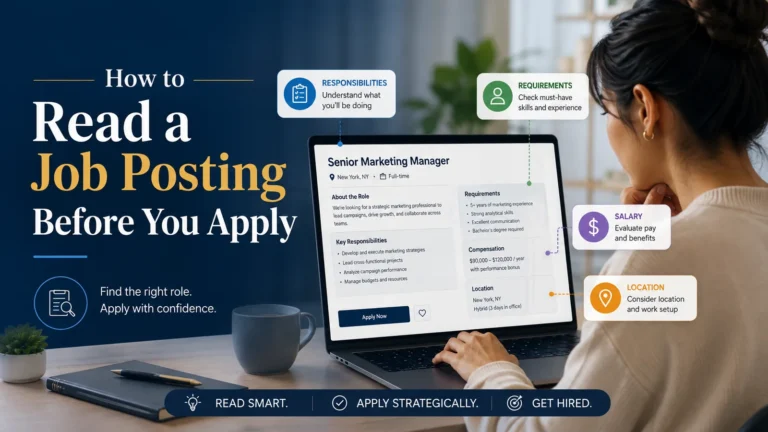
Search current vacancies for each option. Record repeated responsibilities, required tools, education, experience level, and common job titles. Job advertisements are imperfect, but patterns across several postings show what employers are actually asking for. Do not judge a field from one unusually demanding vacancy.
9. Separate entry-level requirements from senior requirements
A common mistake is reading a senior job description and deciding the entire profession is inaccessible. Compare junior, trainee, associate, specialist, and senior roles. Identify what a beginner must know now and what is expected only after several years. This gives you a realistic entry point.
10. Check formal education, licensing, and regulation
Some careers can be entered through projects, certificates, or experience; others require a specific degree, professional registration, license, or regulated training. Verify this early through official sources. Do not build a long plan around a path only to discover later that a legal or professional requirement changes the route completely.
11. Talk to people who actually do the work
Ask professionals about an ordinary week, not only career highlights. What tasks take most of their time? What is stressful? What did they misunderstand before entering the field? What distinguishes strong beginners? One conversation should not decide your future, but several conversations can challenge assumptions created by social media or job titles.
12. Test the work with a small experiment
Before committing to a long program, try a realistic task. Complete a short project, take a practical course module, volunteer, shadow someone where appropriate, solve a case exercise, or build a portfolio sample. The experiment should resemble the work itself, not only consume information about the field.
13. Score each option using the same criteria
Create a simple table and rate each path on interest, current ability, willingness to learn, access to entry-level opportunities, cost and time of preparation, work-style fit, location, and long-term flexibility. The score is not scientific truth; it forces you to compare options consistently instead of changing your criteria for each one.
14. Narrow the list to two or three serious options
At this stage, eliminate choices that conflict strongly with your priorities or constraints. Keep two or three options that have the best combination of fit and realistic access. You do not need perfect certainty. You need a smaller set that deserves deeper testing.
15. Build one transferable skill across the shortlist
When you are uncertain between related paths, invest in a skill useful across several of them. Communication, writing, data literacy, spreadsheets, project coordination, presentation, customer research, and basic digital fluency often transfer between roles. This reduces the cost of exploration because the work remains useful even if your final choice changes.
16. Choose one 30-day career experiment
Select the option with the strongest evidence and design a 30-day test. Define an output: finish a small project, conduct five informational interviews, complete a practical module, analyze ten vacancies, or create one portfolio piece. The experiment should produce something you can inspect, not only hours spent learning.
17. Ask for feedback from someone who understands the field
Show your project, assumptions, or plan to a professional, mentor, instructor, or experienced practitioner. Ask what looks realistic, what you are underestimating, and what skill would most improve your entry chances. Specific feedback is more valuable than general encouragement.
18. Recheck the market after the experiment
Return to current job advertisements and compare what you learned with market evidence. Avoid making decisions from one headline about “future jobs” or one salary post. Demand differs by city, employer, seniority, specialization, and economic conditions. Look for repeated patterns and official or credible labor-market information.
19. Turn the choice into a six-month plan
Once one path has more evidence behind it, create a six-month plan with measurable milestones. Include the skills to build, projects to complete, people to speak with, applications or internships to target, and a realistic weekly schedule. A career decision becomes useful only when it changes what you do next.
20. Set a review date and allow the decision to evolve
Choose a date—perhaps after three or six months—to review the evidence. Ask what you learned, what changed in the market, what tasks you enjoyed, and where progress was stronger or weaker than expected. Changing direction after new evidence is not failure; it is part of making a better decision.
How to compare two career paths that both look good
Two options can score similarly while leading to very different daily lives. When that happens, compare the work at a deeper level. What problems would you solve every week? How much time is spent communicating, writing, analyzing, selling, designing, coding, traveling, supervising, or handling customers? What kind of pressure is common? What does a beginner actually do in the first year?
Then compare reversibility. Some choices require a large commitment before you can test them; others let you build transferable skills while keeping several routes open. If two paths are equally attractive, the path that lets you gather real evidence at lower cost may be the better experiment first.
A practical comparison table
| Criterion | Questions to ask |
|---|---|
| Interest | Do I enjoy the actual tasks or only the idea of the profession? |
| Ability | What evidence shows I can develop the required skills? |
| Entry access | What does a realistic beginner role require? |
| Learning cost | How much time, money, and formal education are required? |
| Work style | Does the daily environment match how I work best? |
| Market evidence | Are there current roles in locations and industries I can access? |
| Flexibility | Will the skills remain useful if I change direction later? |
Career-choice traps to avoid
Choosing only because the field is popular
A rapidly growing field may still be a poor fit if you dislike the work or cannot realistically meet the entry requirements. Popularity should trigger research, not automatic commitment.
Choosing only because of a salary number
Salary varies by country, city, employer, experience, specialization, performance, and economic conditions. A high published figure may describe a senior role that takes years to reach. Compare entry routes and progression, not only the highest number you can find.
Letting family or friends make the decision for you
Advice from people who know you can be useful, especially about strengths and constraints. But their image of a career may be outdated or shaped by their own priorities. Use their advice as one source of evidence, not the final decision.
Collecting courses before choosing a target
Courses feel productive because they create activity. But without a target, it is easy to accumulate certificates that do not strengthen a specific application. Choose the role first, then identify the smallest learning path that closes a real gap.
Waiting for complete certainty
You cannot know exactly how a career will feel before doing the work. Controlled experiments reduce uncertainty more effectively than months of thinking. Aim for enough evidence to choose the next step, not enough information to predict your entire life.
What if you chose a major but do not want its obvious career path?
A degree influences your starting point, but it does not always determine your final profession. Start by identifying transferable knowledge and skills from your studies, then look for adjacent roles where that background is useful. A business graduate may move toward analytics, operations, sales, HR, or product support. An engineering graduate may move into project management, technical sales, quality, operations, or specialized analysis, depending on skills and requirements.
Do not hide your degree as though it was wasted. Explain how it supports the new direction, and build practical evidence for the skills that the new role requires.
What if you have several strong interests?
You do not need to eliminate every interest. Choose one primary path for your job search and keep secondary interests as projects, electives, or future options. Employers need to understand what role you are applying for now. Your career can still contain multiple chapters over time.
If two interests combine naturally, look for intersection roles. For example, healthcare and data, education and technology, finance and analytics, design and research, or engineering and project management. But verify that the combined role exists in real job advertisements rather than inventing a title that the market does not use.
A 30-day decision experiment
Week 1: Research
Collect ten to fifteen job descriptions across your top two options. Record the repeated skills, qualifications, and beginner responsibilities.
Week 2: Try the work
Complete one realistic task from each option. Keep the scope small enough to finish, but realistic enough to expose whether you like the process.
Week 3: Speak to practitioners
Have at least two conversations with people working in or near the fields. Ask about normal work, difficult tasks, entry mistakes, and how performance is measured.
Week 4: Compare evidence
Score the options again, document what changed in your assumptions, and select the next six-month direction.
Career-path decision checklist
- I have reviewed multiple current job advertisements, not just career-description websites.
- I understand the education or licensing requirements where they apply.
- I know what an entry-level person actually does.
- I have tested at least one realistic task from the field.
- I have spoken with someone who understands the work.
- I know the main skill gaps between me and an entry role.
- I understand the practical cost and time required to close those gaps.
- I have compared the option with at least one alternative using the same criteria.
- I have a six-month plan with measurable outputs.
- I have set a date to review the decision rather than treating it as permanent.
The most useful career decision is the one you can test
A career path is not a label you discover once. It is a sequence of decisions informed by your abilities, preferences, opportunities, constraints, and the evidence you collect from real work. The market will change, and you will change with experience. That is why the objective is not to predict your entire future.
Choose the option with the strongest evidence today, take a concrete step, and pay attention to what happens. A small project, a conversation with a practitioner, or one month of focused learning can teach you more than another month of comparing job titles. Your path becomes clearer through action that produces evidence.
How this page was prepared and when it is reviewed
Method: The article turns a career question into a practical method, gives concrete examples, and preserves source links for facts that can change.
Review trigger: Review the plan after one short execution cycle, then record the change, its evidence, and the resulting decision.
For changing information, check the original source before making an important decision.
Sources and verification
Last checked: 2026-08-19- Official sourceCareer Path Service – HRDFhrdf.org.sa
- Official sourceCareer Guidance (Subol) – HRDFhrdf.org.sa
- Official sourceMicrosoft Learn – Career pathslearn.microsoft.com
Sources support the framework and reference data; professional application varies by organization, situation, and date.

The Mahana editorial team reviews career articles, guides, links, and time-sensitive information under the published editorial policy.
Editorial and verification method