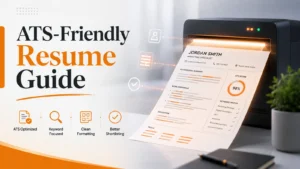
Rewrite Your Resume for a Career Change
Practical steps to show transferable capability and recent evidence without pretending your previous career was the same job. Final output: a hybrid resume that connects prior results to the new role.

Weigh options against explicit criteria and do not override a non-negotiable constraint.
For: People planning a career change or next stepA hybrid resume that connects prior results to the new role
Show transferable capability and recent evidence without pretending your previous career was the same job.
Use the hybrid resume that connects prior results to the new role as an updateable decision record, not a fixed template.
A career-change resume must connect past results to a new role without renaming your history or overstating your readiness. Use the sections below to build that bridge from target-role evidence, transferable capability, and recent proof.
Start with the target role, not the old career
Collect several postings for the role you want and identify recurring skills and responsibilities. Then return to your previous experience and look for evidence that genuinely transfers.
Choose three transferable capabilities
Select capabilities such as analysis, project coordination, customer communication, reporting, or stakeholder management. Do not simply say the fields are similar; show where you used the capability.
Rewrite achievements in the language of the new role
Change the angle, not the facts. For example, a teacher moving toward project coordination can describe schedules, stakeholders, resources, and risk rather than only classroom duties.
Add recent proof
A focused project, practical course output, volunteer assignment, or portfolio sample in the new field helps close the evidence gap. Show what you built or decided, not just the course name.
Reduce older detail that no longer supports the target
Do not erase your history, but do not give every old role equal space. Expand relevant proof and shorten duties that add little to the new direction.
Use the summary to explain the bridge
In two or three lines, state your background, transferable strengths, and target role. Avoid apologizing for the change or presenting yourself as an expert before you have the evidence.
Run the interview test
For every bullet, be able to explain the context, your action, the result, and how that experience helps in the new role.
Final review
- Does each transferable capability point to a real example from your work?
- Have you kept official titles and responsibilities truthful?
- Is recent proof in the new field easy to find?
- Can you explain the career bridge in two or three sentences?
A transfer map
| Previous experience | Transferable capability | New proof |
|---|---|---|
| Customer service | Problem solving and communication | Customer-journey improvement case |
| Teaching | Facilitation and group management | Learning-design project |
| Sales | Relationship and pipeline management | CRM or pipeline analysis |
| Operations | Coordination and improvement | Process map with measurable indicators |
Use the map to generate your own evidence. Do not copy an example that does not match your history.
A before-and-after career-change bullet
A customer-service professional moving into operations might replace “Answered customer enquiries” with “Categorised recurring enquiries into five causes and shared the patterns with the team to improve standard responses and procedures.” The facts stay honest while the transferable analysis and improvement work becomes visible.
What you should not hide
Do not rename an old job to a title from the new field, inflate responsibility, or present a short course as work experience. You can add a clarifying description when an internal title is unclear, but the official role and scope should remain truthful.
A 14-day evidence sprint
- Days 1–2: collect target-role postings.
- Days 3–4: identify three repeated gaps.
- Days 5–10: build one small project addressing a gap.
- Days 11–12: request feedback from someone in the field.
- Days 13–14: update the resume and LinkedIn with the project evidence.
Questions about this guide
How should I begin Rewrite Your Resume for a Career Change?
Write the current situation and required result, then build a first version of the hybrid resume that connects prior results to the new role.
How do I know the hybrid resume that connects prior results to the new role is usable?
Another person should be able to understand the decision or document, identify the source, and see the next action without a long verbal explanation.
When should I review it again?
Review it when material information changes or after the final step is used, and record the change in the hybrid resume that connects prior results to the new role.
Start with one checkpoint, keep every decision visible in the hybrid resume that connects prior results to the new role, and review the result before expanding the approach.
View all guidesHow this page was prepared and when it is reviewed
Method: The guide turns “Show transferable capability and recent evidence without pretending your previous career was the same job.” into checkpoints tied to one output, the hybrid resume that connects prior results to the new role, while separating facts from assumptions and linking changing information to its sources.
Review trigger: Review the hybrid resume that connects prior results to the new role when material information changes or after its first real use; record the change, its reason, and the result observed afterwards.
For changing information, check the original source before making an important decision.
Sources and verification
Last checked: 2026-08-20- Official sourceResume guidance — HRDFhrdf.org.sa
- Official sourceJob applications — Jadarathrdf.org.sa
Sources support the framework and reference data; professional application varies by organization, situation, and date.

The Mahana editorial team reviews career articles, guides, links, and time-sensitive information under the published editorial policy.
Editorial and verification method