
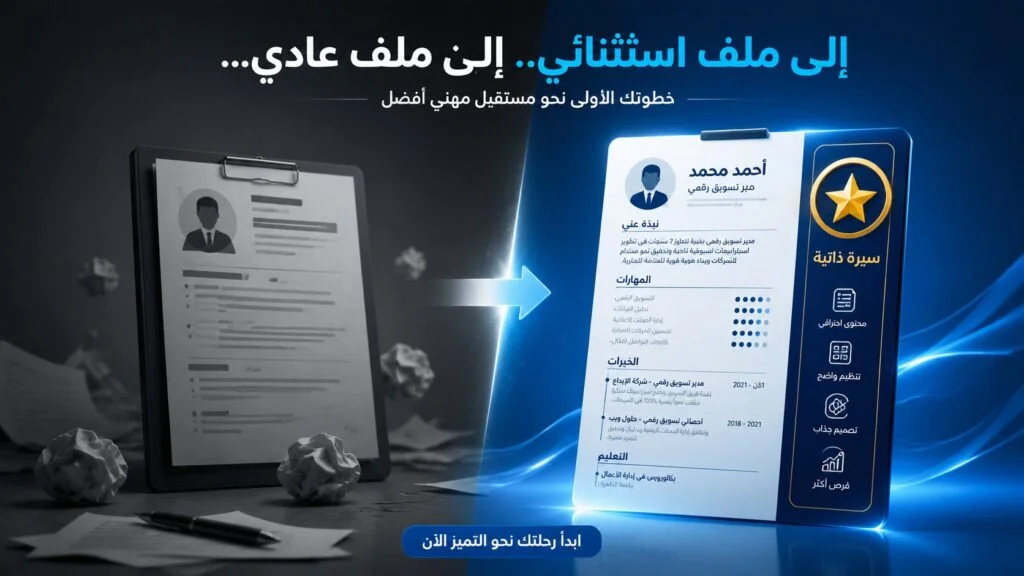
A professional profile is the complete picture an employer forms about you before and during the hiring process. It is not limited to a resume, and it is not the same as having an attractive LinkedIn page. It is the combination of your resume, online presence, portfolio, projects, professional summary, work examples, references, and the way all of those pieces tell one consistent story about what you can do.
That consistency matters because recruiters rarely evaluate one document in isolation. A hiring manager may read your resume, search your name, open your LinkedIn profile, check a portfolio link, and compare what you wrote in the application with what appears elsewhere. A strong profile makes that review easy. A weak profile forces the employer to guess what you specialize in, what level you are at, or whether your claims are reliable.
The goal of this guide is practical: build a profile that is clear, credible, easy to verify, and relevant to the jobs you actually want. You do not need to look perfect or claim experience you do not have. You need to present your real experience in a way that helps another person understand your value quickly.
Quick summary
- A professional profile is bigger than a resume; it includes every professional touchpoint an employer can reasonably review.
- Start with a clear target role or career direction before rewriting your documents.
- Use evidence—projects, results, examples, and specific responsibilities—instead of vague adjectives.
- Keep dates, titles, skills, and major claims consistent across your resume, LinkedIn, portfolio, and applications.
- Make your strongest evidence visible early instead of hiding it under long introductions.
- Review the profile from the employer’s point of view and update it whenever your experience materially changes.
1. Decide what your professional profile is trying to communicate
Before changing a headline, template, or profile photo, decide what you want the reader to understand. If you are applying for several unrelated types of work at the same time, your profile can become too broad to be useful. The employer should be able to answer three questions quickly: What kind of role is this person targeting? What evidence shows they can do it? What is the logical next step in their career?
Write a one-sentence positioning statement for yourself. For example: “Junior data analyst with hands-on dashboard and reporting projects, seeking an entry-level analytics role.” Or: “Customer service specialist with experience handling high-volume inquiries and improving response quality.” This sentence is not necessarily something you publish word for word; it is a filter that helps you decide what belongs in the profile and what does not.
If you are still exploring, choose the strongest direction for the next few months rather than trying to solve your entire career permanently. A profile can evolve. Clarity today is more useful than an identity that tries to cover every possible future role.
2. Audit what an employer can already see
Search your name and review the same public information a recruiter might see. Open your resume, LinkedIn profile, portfolio, public project pages, professional social accounts, and any old profile that still appears in search results. You are looking for contradictions, outdated information, broken links, and content that distracts from your current direction.
- Are your current job title and dates consistent?
- Does your location match the location you are willing to work in?
- Are old portfolio links still functioning?
- Do public bios describe a completely different career direction?
- Are there projects that should be hidden because they are unfinished, outdated, or confidential?
- Can an employer find a professional way to contact you?
This audit is not about removing your personality from the internet. It is about making sure the professional information you actively present is accurate and coherent.
3. Build a resume that acts as the core record
Your resume is usually the most structured version of your professional history, so treat it as the factual reference point for dates, roles, education, and major achievements. Avoid filling it with generic claims such as “hardworking,” “passionate,” or “excellent communicator” unless the surrounding experience demonstrates those qualities.
For each role or project, describe the work in terms of contribution. A useful bullet usually contains an action, a meaningful task or problem, and a result or outcome when one can be stated honestly. Not every bullet needs a percentage. If you do not have reliable numbers, describe the scale, frequency, complexity, audience, or improvement without inventing metrics.
Weak vs. stronger evidence
- Weak: “Responsible for social media.” Stronger: “Planned and published the weekly content calendar across three social channels and coordinated approvals with the design team.”
- Weak: “Worked on reports.” Stronger: “Prepared the weekly operations report by consolidating data from sales and service teams and flagging incomplete records before submission.”
- Weak: “Good at teamwork.” Stronger: “Coordinated a four-person student project, assigned deliverables, and maintained the final submission schedule.”
A resume becomes more convincing when the reader can picture the work. Specificity is often more valuable than decorative language.
4. Make LinkedIn support the resume instead of copying it
Your LinkedIn profile should agree with the resume on factual information, but it does not need to repeat every sentence. LinkedIn gives you additional space to explain context, show projects, list selected skills, connect to a portfolio, and make your professional direction visible to people who have not received your resume.
Use the headline to communicate your role or target direction clearly. Avoid a headline made entirely of motivational words. In the About section, explain what you work on, what kind of problems you are good at handling, what evidence supports that, and what type of opportunity you are interested in. Keep the opening lines strong because they are the portion most likely to be seen before the reader expands the section.
In the Experience section, prioritize the responsibilities and outcomes most relevant to your target roles. In Featured, place only links that strengthen your case: a portfolio, a documented project, a presentation, a publication, a case study, or another professional sample.
5. Create proof of work when experience alone is not enough
A common problem for new graduates and career changers is the sentence: “I cannot build a portfolio because I have not had the job yet.” In many fields, you can create evidence without pretending it was paid client work. The key is to label it honestly as a personal, academic, volunteer, or practice project.
- A data applicant can analyze a public dataset and document the questions, method, dashboard, and conclusions.
- A developer can publish a small working project with a clear README explaining the problem and technical decisions.
- A designer can create a case study that shows research, alternatives, and reasoning—not only final screens.
- A marketer can build a sample campaign brief, content plan, or channel analysis using a realistic scenario.
- An HR applicant can create a structured onboarding checklist, interview scorecard, or training-needs exercise without using private employee data.
- A project coordinator can show a sample plan, risk register, status report, or retrospective based on a fictional or academic project.
The purpose is not to create a large gallery. Two or three well-explained examples often provide more useful evidence than twenty files with no explanation.
6. Write project descriptions that show how you think
A portfolio item should answer more than “What did you make?” Explain the situation, goal, constraints, your role, the method you used, and what changed as a result. If the result was not successful, describe what you learned and what you would change. Recruiters often care about judgment and process, not only polished output.
A simple structure works well: context → problem → your contribution → tools or method → result → lesson. This format is useful across technical, creative, business, academic, and operational work.
7. Keep your professional story consistent across channels
Consistency does not mean identical wording everywhere. It means the facts and overall direction do not conflict. If your resume says you worked at a company from 2023 to 2025 while LinkedIn says 2022 to 2024, that creates unnecessary doubt. If one profile calls you a senior specialist and another describes the same period as an internship, the mismatch is more serious.
Review job titles, dates, degree names, certifications, skill claims, and major accomplishments. When a title was unusual inside the organization, you can add a clarifying equivalent in parentheses rather than changing it to something that overstates your role.
8. Choose skills based on evidence and target roles
A long skills list is not automatically stronger. Select skills that appear in your target job descriptions and that you can discuss or demonstrate. Divide them mentally into three groups: skills you can already prove, skills you are actively developing, and skills you do not yet have. Only the first group should be presented as established strengths.
For technical tools, be honest about level. “Used Excel to clean and summarize weekly data” is more credible than listing “Advanced Excel” without examples. For soft skills, attach the claim to behavior: communication through presentations or customer handling, leadership through coordinating a team, problem solving through a documented improvement or investigation.
9. Use keywords without turning the profile into keyword stuffing
Applicant-tracking systems and recruiter searches make terminology important, but copying every phrase from a vacancy produces an unnatural profile and can create claims you cannot defend. Use the standard name of skills, tools, certifications, and job functions when they genuinely apply to you.
Tailor the resume for each job by adjusting emphasis. If a role values reporting, bring reporting evidence forward. If another values customer communication, highlight relevant examples. The factual history stays the same; the order and detail can change to match the job.
10. Build a credible professional summary
A good summary helps the reader understand your level and direction in a few lines. It should not sound like an advertisement. State your role or field, relevant experience or training, strongest evidence, and the type of contribution you are prepared to make.
For a new graduate, that may include degree, practical projects, internship exposure, and target role. For an experienced professional, focus on the problems you handle, scope of responsibility, and relevant outcomes. Avoid claiming to be an “expert” unless your experience clearly supports it.
11. Make contact information and links frictionless
Do not lose an opportunity because the employer cannot reach you or because a portfolio link requires permissions. Use an email address you monitor, verify your phone number, and test links from a device where you are not already logged in. If you include a portfolio PDF, confirm it loads on mobile and the file size is reasonable.
Avoid publishing sensitive personal information that is not required for the application. The exact information requested varies by employer and country, so follow the job application requirements rather than adding private details “just in case.”
12. Use recommendations and references carefully
Recommendations can strengthen credibility when they come from people who actually observed your work. A useful recommendation describes a specific behavior, project, or contribution. A generic sentence from a person who barely knows your work is less valuable.
Do not publish someone’s contact details as a reference without permission. If an employer requests references, confirm the person is willing to be contacted and give them context about the role so they understand what may be discussed.
13. Review your profile from the recruiter’s first-minute perspective
Imagine a recruiter gives your materials sixty seconds. Can they identify your target role, recent experience, strongest evidence, and key skills without searching? If not, improve hierarchy before adding more content.
- Put the most relevant experience and evidence where it can be found quickly.
- Remove repeated sentences that say the same thing in different words.
- Break long blocks of text into readable sections.
- Use clear labels for projects and links.
- Check the mobile view, because recruiters may open profiles from a phone.
- Make sure the profile is understandable without insider knowledge of your previous organization.
14. Avoid the mistakes that make a profile look stronger than it is
- Inflating job titles or responsibility.
- Using metrics you cannot verify.
- Listing every course as though it were professional experience.
- Publishing confidential work samples.
- Copying generic AI-generated language without checking whether it describes you accurately.
- Using a different career identity on every platform.
- Adding too many unrelated skills because they look impressive.
- Leaving old links, typos, or outdated dates in public profiles.
Credibility compounds. Small accurate details build trust; small contradictions weaken it.
15. A practical seven-day profile improvement plan
Day 1: Define your target
Choose one primary role or career direction and collect five to ten real job descriptions. Highlight repeated responsibilities, skills, tools, and terminology.
Day 2: Fix the factual foundation
Verify dates, titles, education, certifications, contact information, and links across the resume and LinkedIn. Correct contradictions before rewriting style.
Day 3: Rewrite experience as evidence
Choose your three most relevant roles or projects and replace generic duties with specific contributions. Add measured results only where they are reliable.
Day 4: Improve LinkedIn
Rewrite the headline and opening of the About section, update the most relevant experience, and add one or two strong Featured items.
Day 5: Build or improve one proof-of-work sample
Create or document a project that demonstrates a skill required in your target roles. Focus on explanation and evidence, not decorative presentation.
Day 6: Run the recruiter scan
Review the resume and profile on desktop and mobile. Ask another person what role they think you are targeting after a one-minute scan.
Day 7: Prepare the application version
Tailor the resume to one real vacancy, verify the keywords you genuinely match, and save a clean version with a professional file name.
Final checklist before applying
- The target role or direction is clear.
- Your resume and LinkedIn agree on dates and core facts.
- Your strongest claims have evidence.
- Projects clearly state your role and method.
- Portfolio and profile links open correctly.
- Your skills are relevant and defensible in an interview.
- Contact details are current.
- No confidential or unnecessary personal information is exposed.
- The profile is easy to scan on mobile.
- The application version has been tailored to the specific vacancy without changing the truth.
The profile should keep changing as your evidence improves
A professional profile is not a one-time design project. Update it after a meaningful project, a new responsibility, verified training, a promotion, or a measurable result. Remove material that no longer supports your direction. The aim is not to make the profile longer; it is to make the evidence clearer.
The strongest profile is usually not the one with the most adjectives, certifications, or pages. It is the one that gives an employer a coherent answer to a simple question: “Why should I believe this person can contribute in this role?” Build every part of the profile to make that answer easier to see.
How this page was prepared and when it is reviewed
Method: The article turns a career question into a practical method, gives concrete examples, and preserves source links for facts that can change.
Review trigger: Refresh the evidence whenever a project is completed or a verifiable result becomes available.
For changing information, check the original source before making an important decision.
Sources and verification
Last checked: 2026-08-19- ReferenceLinkedIn Help – Manage your profilelinkedin.com
- ReferenceLinkedIn Help – Open to Work settingslinkedin.com
- Official sourceCareer Guidance (Subol) – HRDFhrdf.org.sa
Sources support the framework and reference data; professional application varies by organization, situation, and date.

The Mahana editorial team reviews career articles, guides, links, and time-sensitive information under the published editorial policy.
Editorial and verification method