
How to use the Salary negotiation planner
The salary-negotiation planner organises a conversation before you answer an offer or compensation review. It turns the current offer, target, evidence of value, alternatives, and questions into concise points you can adapt.
Go to the relevant information, then verify the source and date before a binding decision.
For: Job seekers and working professionalsComplete a practical output for “How to use the Salary negotiation planner”.
When should you use Salary negotiation planner?
Limits and when to use another source
When should you use Salary negotiation planner?
The salary-negotiation planner organises a conversation before you answer an offer or compensation review. It turns the current offer, target, evidence of value, alternatives, and questions into concise points you can adapt.
Limits and when to use another source
The planner cannot know the employer's budget, the strength of your alternatives, or current market conditions. Some pay bands are fixed; a development review, sign-on item, flexibility, or time to consider may be a better alternative than repeating the same demand.
How to use Salary negotiation planner step by step
- Set target, floor, and alternatives before writing the opening request.
- Choose two evidence points tied to role scope or supported value, not personal expenses.
- Draft the request, likely employer responses, and questions about the complete package.
- Practise concise delivery and record any agreement in the final written offer.

How should you read the result?
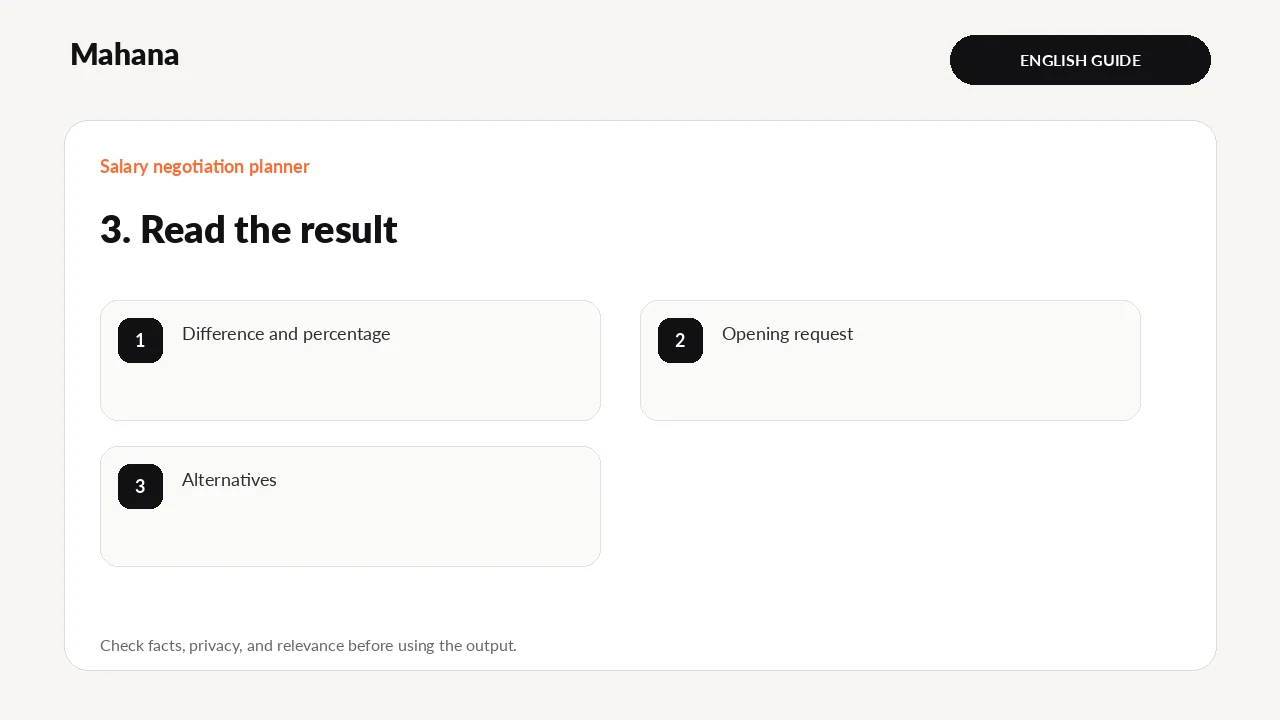
The result includes the difference, percentage, opening request, supporting evidence, and alternatives. Use it as a conversation outline—not a script that must be read word for word.
- Difference and percentage
- Opening request
- Alternatives
Questions about Salary negotiation planner
Does Mahana receive the normal salary-negotiation planner inputs?
The salary-negotiation planner is designed to process its normal fields in the browser. For the salary-negotiation planner, avoid sensitive data and read the page privacy note before using any optional storage, export, or sharing function.
Is the salary-negotiation planner result guaranteed?
No. The salary-negotiation planner returns a draft, comparison, or estimate from the values entered. For the salary-negotiation planner, employer decisions, official entitlements, and professional outcomes depend on facts the tool cannot see.
What must I do before using the salary-negotiation planner result?
Before using a salary-negotiation planner result, check every fact, remove unnecessary personal data, compare calculations with the latest official source, and edit it for the real recipient or decision.
What does the tool actually do?
- Calculates the requested difference and percentage from the current offer.
- Builds an opening around evidence supplied by the user.
- Organises target, alternatives, and questions without claiming a market price.
This describes the current transparent logic; it does not guarantee a hiring decision or legal entitlement. Behaviour and content last checked: 2026-08-15.
A realistic worked example
A project-manager candidate receives SAR 17,000 and targets SAR 19,000. They connect the request to documented schedule improvements and the new role's larger portfolio, then invite discussion of salary or another meaningful package component.
Interpretation: The request is stronger when it links a specific adjustment to documented scope and keeps workable alternatives. The acceptable floor remains private unless disclosure serves a deliberate strategy.
Review before you rely on it
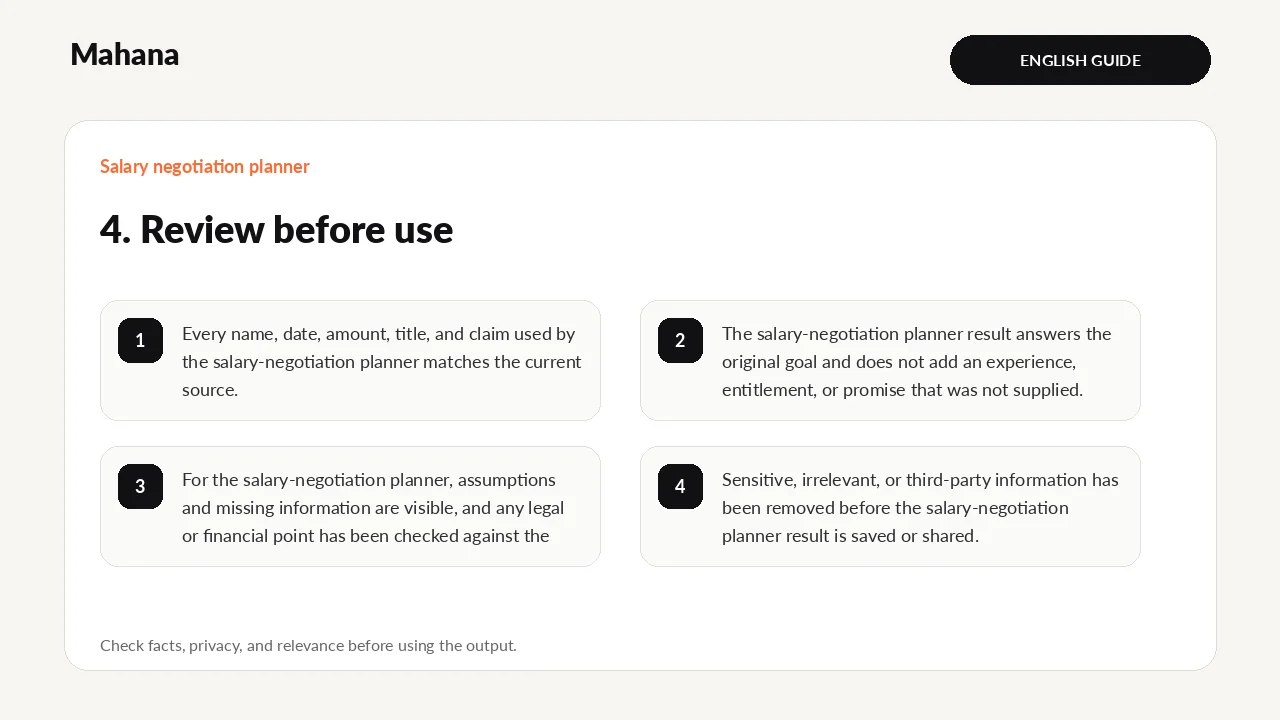
- Every name, date, amount, title, and claim used by the salary-negotiation planner matches the current source.
- The salary-negotiation planner result answers the original goal and does not add an experience, entitlement, or promise that was not supplied.
- For the salary-negotiation planner, assumptions and missing information are visible, and any legal or financial point has been checked against the latest official source.
- Sensitive, irrelevant, or third-party information has been removed before the salary-negotiation planner result is saved or shared.
Review the salary-negotiation planner result once as its intended reader. For the salary-negotiation planner, check facts first, then relevance, wording, layout, and privacy in separate passes; ask a qualified person to review a difficult-to-reverse decision.
What should you prepare?
Review the full role scope and package and collect two credible value examples, such as a documented result, relevant specialist experience, or an expanded responsibility. Decide your request, acceptable alternatives, and response deadline.
- The written offer and the exact element to negotiate.
- A target, acceptable floor, and alternatives that are genuinely usable.
- Evidence from responsibilities, experience, results, or credible market information.
Privacy first: The salary-negotiation planner does not need identity numbers, passwords, bank details, medical records, private referee data, or confidential employer material. Replace names and restricted figures with neutral examples wherever possible.

What is included in this version?
- A worked example written specifically for the salary-negotiation planner.
- Visible assumptions, privacy guidance, and result limitations.
- An editable result plus a separate pre-use review checklist.
Mistakes that weaken the result
- Using incomplete or inconsistent inputs in the salary-negotiation planner and treating the result as authoritative.
- Copying the salary-negotiation planner result without checking facts, tone, calculations, names, or audience.
- Adding a skill, achievement, amount, or entitlement that the salary-negotiation planner cannot verify and the user cannot support.
- Sharing sensitive information with the salary-negotiation planner when a redacted or fictional example would be enough.
Your next action
Practise the opening request and alternatives, then document the final agreement in the revised offer.
Guide method: The instructions were checked against the current fields and outputs. Results remain editable guidance, not a final professional determination.
Continue with the tool or browse all career tools.
The salary-negotiation planner organises a conversation before you answer an offer or compensation review. It…
Open Salary negotiation plannerHow this page was prepared and when it is reviewed
Method: The guide turns one defined career question into steps and a reviewable output, with changing claims tied to their sources.
Review trigger: Review this page when relevant rules, tools, or market evidence changes, or when a newer authoritative source becomes available.

The Mahana editorial team reviews career articles, guides, links, and time-sensitive information under the published editorial policy.
Editorial and verification method