
How to use the Career SWOT analysis
Career SWOT analysis separates internal factors—strengths and gaps—from external factors—opportunities and threats—then turns the highest-priority combinations into action. Use it for a career change, promotion decision, or learning plan.
Go to the relevant information, then verify the source and date before a binding decision.
For: Job seekers and working professionalsComplete a practical output for “How to use the Career SWOT analysis”.
When should you use Career SWOT analysis?
Limits and when to use another source
When should you use Career SWOT analysis?
Career SWOT analysis separates internal factors—strengths and gaps—from external factors—opportunities and threats—then turns the highest-priority combinations into action. Use it for a career change, promotion decision, or learning plan.
Limits and when to use another source
SWOT is a time-specific decision snapshot, not a personality diagnosis or market forecast. Test the assumptions with a project, conversation, vacancy sample, or application data before making a difficult-to-reverse decision.
What does the tool actually do?
- Separates internal strengths and gaps from external opportunities and threats.
- Builds action prompts that connect the four quadrants.
- Does not diagnose personality or objectively forecast the labour market.
This describes the current transparent logic; it does not guarantee a hiring decision or legal entitlement. Behaviour and content last checked: 2026-08-15.
Questions about Career SWOT analysis
Does Mahana receive the normal career SWOT analysis inputs?
The career SWOT analysis is designed to process its normal fields in the browser. For the career SWOT analysis, avoid sensitive data and read the page privacy note before using any optional storage, export, or sharing function.
Is the career SWOT analysis result guaranteed?
No. The career SWOT analysis returns a draft, comparison, or estimate from the values entered. For the career SWOT analysis, employer decisions, official entitlements, and professional outcomes depend on facts the tool cannot see.
What must I do before using the career SWOT analysis result?
Before using a career SWOT analysis result, check every fact, remove unnecessary personal data, compare calculations with the latest official source, and edit it for the real recipient or decision.
Review before you rely on it
- Every name, date, amount, title, and claim used by the career SWOT analysis matches the current source.
- The career SWOT analysis result answers the original goal and does not add an experience, entitlement, or promise that was not supplied.
- For the career SWOT analysis, assumptions and missing information are visible, and any legal or financial point has been checked against the latest official source.
- Sensitive, irrelevant, or third-party information has been removed before the career SWOT analysis result is saved or shared.
Review the career SWOT analysis result once as its intended reader. For the career SWOT analysis, check facts first, then relevance, wording, layout, and privacy in separate passes; ask a qualified person to review a difficult-to-reverse decision.

A realistic worked example
A marketer considering growth analytics records campaign analysis as a supported strength, SQL as a gap, hybrid marketing-data roles as an opportunity, and technically stronger applicants as a threat. The next action is a small SQL-based campaign project and feedback.
Interpretation: The grid is valuable only when assumptions lead to a test. A small project, practitioner conversation, or vacancy sample can confirm or disprove the most important item before a larger commitment.
How to use Career SWOT analysis step by step
- Write evidence-backed strengths and gaps before considering external conditions.
- Gather current vacancy and practitioner observations for opportunities and threats.
- Rank items by impact, likelihood, control, and time horizon.
- Create one testable action from the highest-priority connection and schedule a review date.

How should you read the result?
The result presents the four lists and suggests links between strengths and opportunities and between gaps and threats. Re-rank every item by impact, likelihood, and the time available to act.
- Strength-opportunity actions
- Strength-threat actions
- Gap-risk actions

Mistakes that weaken the result
- Using incomplete or inconsistent inputs in the career SWOT analysis and treating the result as authoritative.
- Copying the career SWOT analysis result without checking facts, tone, calculations, names, or audience.
- Adding a skill, achievement, amount, or entitlement that the career SWOT analysis cannot verify and the user cannot support.
- Sharing sensitive information with the career SWOT analysis when a redacted or fictional example would be enough.
What is included in this version?
- A worked example written specifically for the career SWOT analysis.
- Visible assumptions, privacy guidance, and result limitations.
- An editable result plus a separate pre-use review checklist.
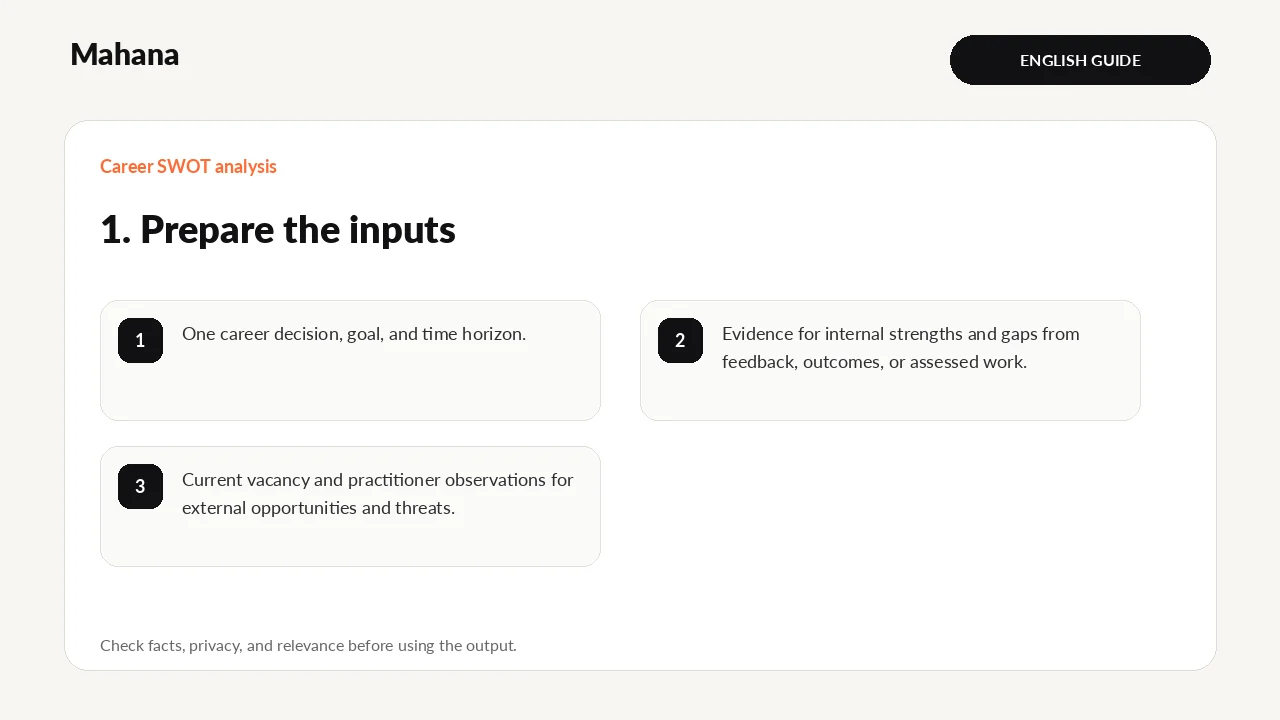
What should you prepare?
Set one career goal and time horizon. Gather performance feedback, real vacancies, and practitioner information, and label what you know separately from what you are assuming.
- One career decision, goal, and time horizon.
- Evidence for internal strengths and gaps from feedback, outcomes, or assessed work.
- Current vacancy and practitioner observations for external opportunities and threats.
Privacy first: The career SWOT analysis does not need identity numbers, passwords, bank details, medical records, private referee data, or confidential employer material. Replace names and restricted figures with neutral examples wherever possible.
Your next action
Run one low-risk test of the highest-impact assumption and set a date to update the matrix.
Guide method: The instructions were checked against the current fields and outputs. Results remain editable guidance, not a final professional determination.
Continue with the tool or browse all career tools.
Career SWOT analysis separates internal factors—strengths and gaps—from external factors—opportunities and thr…
Open Career SWOT analysisHow this page was prepared and when it is reviewed
Method: The guide turns one defined career question into steps and a reviewable output, with changing claims tied to their sources.
Review trigger: Review this page when relevant rules, tools, or market evidence changes, or when a newer authoritative source becomes available.

The Mahana editorial team reviews career articles, guides, links, and time-sensitive information under the published editorial policy.
Editorial and verification method