
How to use the Job offer evaluator
Use the job-offer evaluator after receiving a written offer and before accepting or negotiating. It brings salary, benefits, growth, stability, flexibility, and risk questions into one review. It cannot know your priorities, manager quality, or personal constraints, so…
Go to the relevant information, then verify the source and date before a binding decision.
For: Job seekers and working professionalsComplete a practical output for “How to use the Job offer evaluator”.
When should you use Job offer evaluator?
How to use Job offer evaluator step by step
When should you use Job offer evaluator?
Use the job-offer evaluator after receiving a written offer and before accepting or negotiating. It brings salary, benefits, growth, stability, flexibility, and risk questions into one review. It cannot know your priorities, manager quality, or personal constraints, so weights remain your decision.
How to use Job offer evaluator step by step
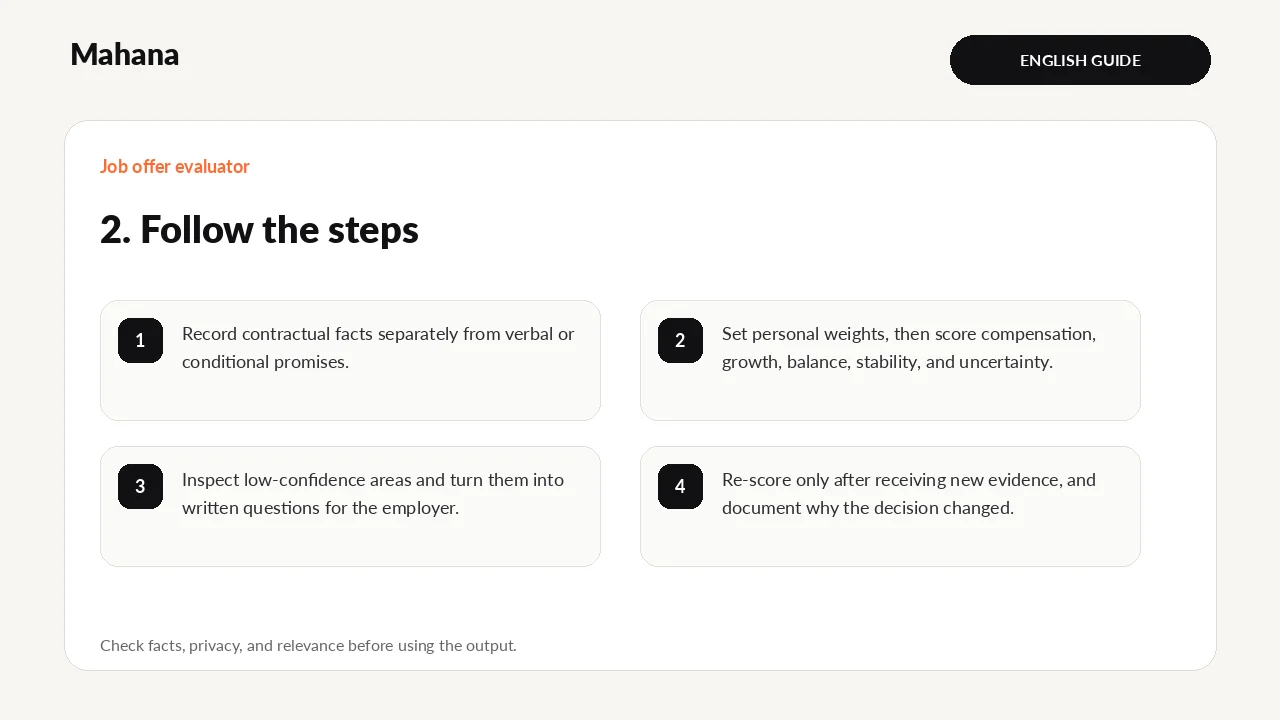
- Record contractual facts separately from verbal or conditional promises.
- Set personal weights, then score compensation, growth, balance, stability, and uncertainty.
- Inspect low-confidence areas and turn them into written questions for the employer.
- Re-score only after receiving new evidence, and document why the decision changed.
How should you read the result?
The result is a decision aid showing the balance between compensation, growth, and uncertainty. Use it to identify unanswered questions and negotiation priorities—not as an automatic accept or reject command.
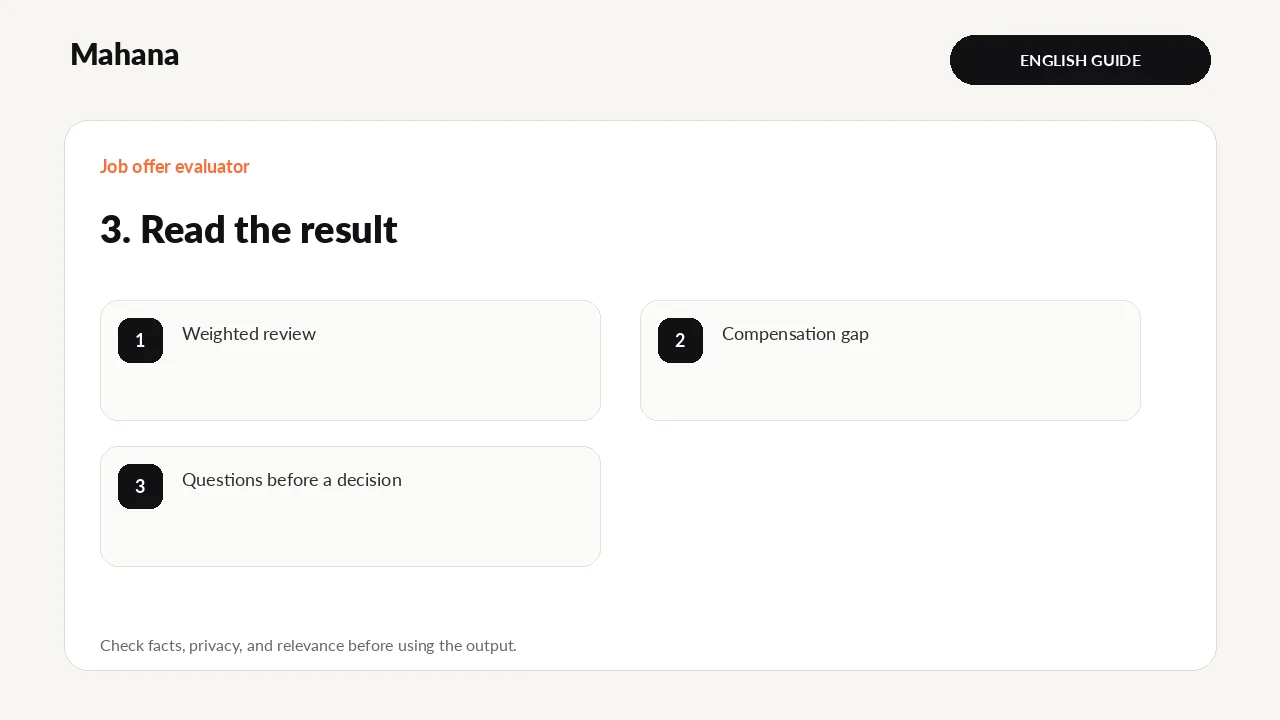
- Weighted review
- Compensation gap
- Questions before a decision
Mistakes that weaken the result
- Using incomplete or inconsistent inputs in the job-offer evaluator and treating the result as authoritative.
- Copying the job-offer evaluator result without checking facts, tone, calculations, names, or audience.
- Adding a skill, achievement, amount, or entitlement that the job-offer evaluator cannot verify and the user cannot support.
- Sharing sensitive information with the job-offer evaluator when a redacted or fictional example would be enough.
A realistic worked example
A candidate records a guaranteed salary increase, labels the bonus as conditional, and lowers the flexibility rating because of a longer commute. The review exposes two questions—team structure and promotion criteria—that could materially change the decision.
Interpretation: The score matters less than the exposed uncertainties. If an unanswered question could reverse the choice, the correct next step is evidence collection—not adjusting the weighting to force a preferred result.
What is included in this version?
- A worked example written specifically for the job-offer evaluator.
- Visible assumptions, privacy guidance, and result limitations.
- An editable result plus a separate pre-use review checklist.
What does the tool actually do?
- Combines entered compensation with the user's own ratings for benefits, growth, balance, and risk.
- Keeps the weighting visible and turns uncertainty into follow-up questions.
- Does not make a binding financial, legal, or career recommendation.
This describes the current transparent logic; it does not guarantee a hiring decision or legal entitlement. Behaviour and content last checked: 2026-08-15.
Questions about Job offer evaluator
Does Mahana receive the normal job-offer evaluator inputs?
The job-offer evaluator is designed to process its normal fields in the browser. For the job-offer evaluator, avoid sensitive data and read the page privacy note before using any optional storage, export, or sharing function.
Is the job-offer evaluator result guaranteed?
No. The job-offer evaluator returns a draft, comparison, or estimate from the values entered. For the job-offer evaluator, employer decisions, official entitlements, and professional outcomes depend on facts the tool cannot see.
What must I do before using the job-offer evaluator result?
Before using a job-offer evaluator result, check every fact, remove unnecessary personal data, compare calculations with the latest official source, and edit it for the real recipient or decision.
What should you prepare?
Request the written offer and record basic salary, fixed and conditional allowances, insurance, leave, probation, location, working pattern, and start date. Rank your priorities before viewing a score so you do not adjust the weights merely to justify an existing preference.
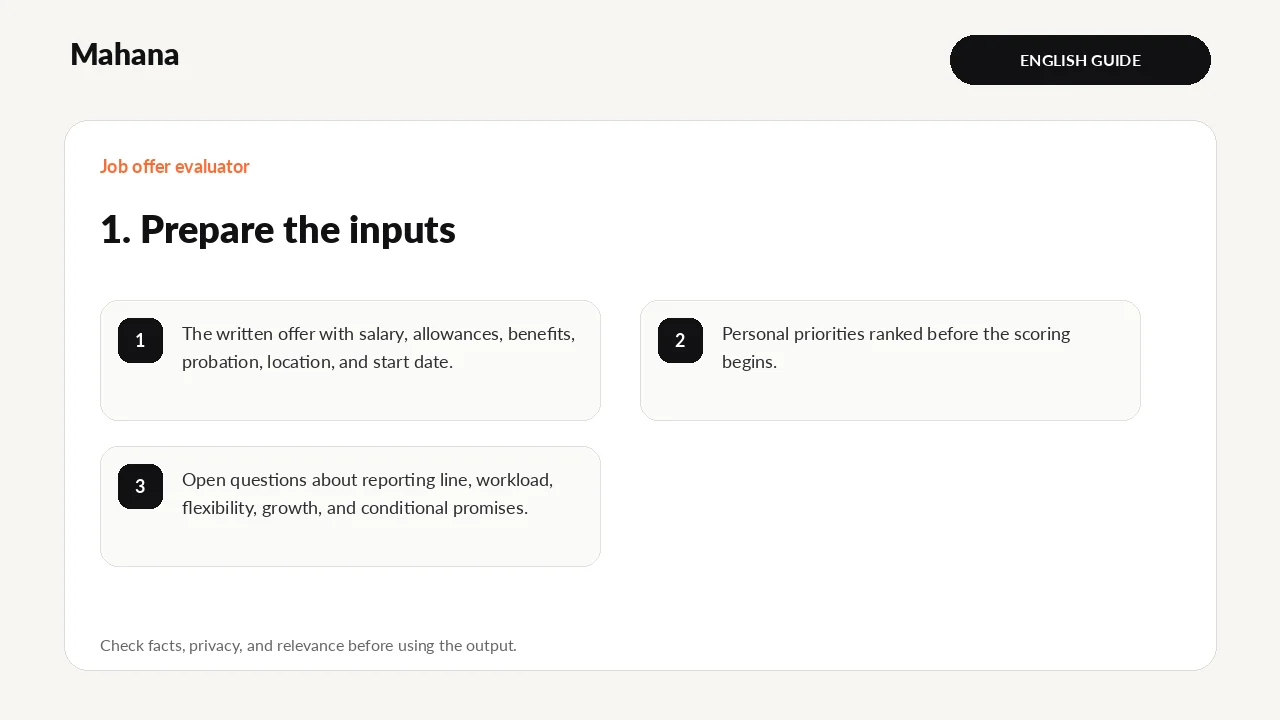
- The written offer with salary, allowances, benefits, probation, location, and start date.
- Personal priorities ranked before the scoring begins.
- Open questions about reporting line, workload, flexibility, growth, and conditional promises.
Privacy first: The job-offer evaluator does not need identity numbers, passwords, bank details, medical records, private referee data, or confidential employer material. Replace names and restricted figures with neutral examples wherever possible.
Review before you rely on it
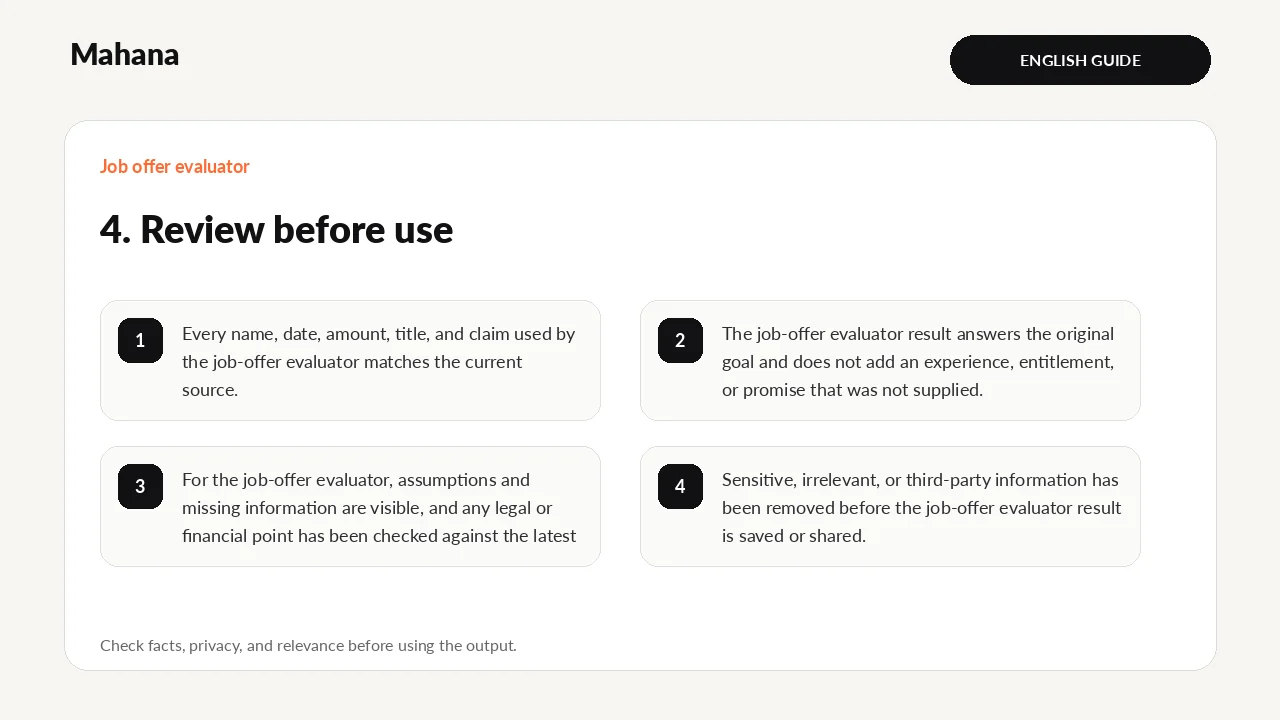
- Every name, date, amount, title, and claim used by the job-offer evaluator matches the current source.
- The job-offer evaluator result answers the original goal and does not add an experience, entitlement, or promise that was not supplied.
- For the job-offer evaluator, assumptions and missing information are visible, and any legal or financial point has been checked against the latest official source.
- Sensitive, irrelevant, or third-party information has been removed before the job-offer evaluator result is saved or shared.
Review the job-offer evaluator result once as its intended reader. For the job-offer evaluator, check facts first, then relevance, wording, layout, and privacy in separate passes; ask a qualified person to review a difficult-to-reverse decision.
Limits and when to use another source
The evaluator cannot verify promises, team culture, or contract validity and does not give legal advice. Obtain a written clarification for important promises and use qualified advice when a clause or financial commitment is unclear.
Your next action
Send the two or three questions most likely to change the decision and wait for written clarification.
Guide method: The instructions were checked against the current fields and outputs. Results remain editable guidance, not a final professional determination.
Continue with the tool or browse all career tools.
Use the job-offer evaluator after receiving a written offer and before accepting or negotiating. It brings sal…
Open Job offer evaluatorHow this page was prepared and when it is reviewed
Method: The guide turns one defined career question into steps and a reviewable output, with changing claims tied to their sources.
Review trigger: Review this page when relevant rules, tools, or market evidence changes, or when a newer authoritative source becomes available.

The Mahana editorial team reviews career articles, guides, links, and time-sensitive information under the published editorial policy.
Editorial and verification method