
Run an Informational Interview
Practical steps to learn what a role or company is really like before making a career decision. Final output: eight focused questions and a short decision summary.
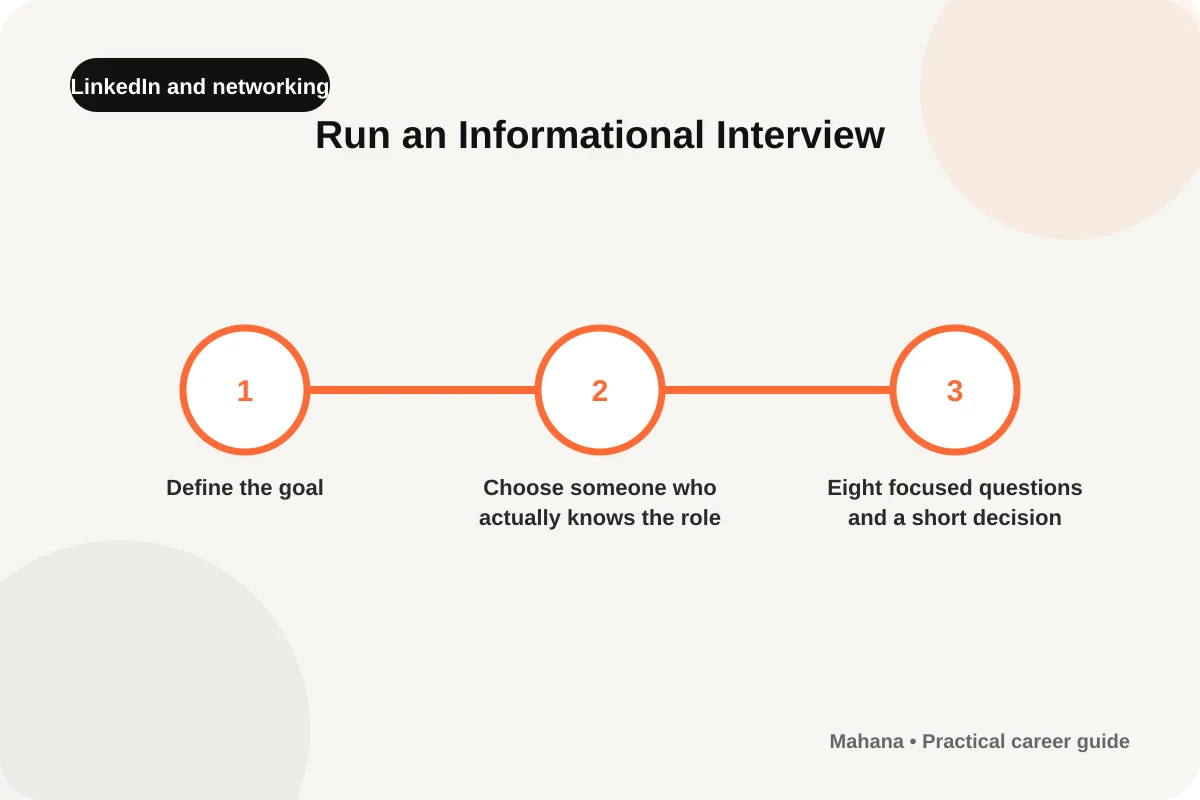
Start with clear wording, then adapt it to the person and context rather than memorising a rigid script.
For: Job seekers and working professionalsEight focused questions and a short decision summary
Learn what a role or company is really like before making a career decision.
Use the eight focused questions and a short decision summary as an updateable decision record, not a fixed template.
This guide helps you learn what a role or company is really like before making a career decision through one defined output: Eight focused questions and a short decision summary. In “Run an Informational Interview,” do not treat the steps as separate tips; each checkpoint should change the eight focused questions and a short decision summary and leave reviewable evidence.
When this guide is useful
For “Run an Informational Interview,” keep profile and outreach claims consistent with evidence you can show. Relevance to the reader matters more than keyword volume.
Use it when you need a decision or document that another person can understand. Before starting, write the current situation, the required result, and the highest-impact constraint so the eight focused questions and a short decision summary reflects your case rather than a generic template.
Build the eight focused questions and a short decision summary through clear checkpoints
Choose someone who actually knows the role
For the “Choose someone who actually knows the role” checkpoint in “Run an Informational Interview,” use explicit criteria and keep the list manageable; for every retained option, write one reason it fits; for every removed option, record the gap that matters. Mark what is complete and what remains open in the eight focused questions and a short decision summary, including the information needed to close it.
Explain that you are seeking insight, not a referral
For the “Explain that you are seeking insight, not a referral” checkpoint in “Run an Informational Interview,” write the first version for the actual reader and purpose; keep the main point near the opening, then support it with only the evidence needed for the next decision. Record the result inside the eight focused questions and a short decision summary so the decision and any follow-up remain visible.
Ask about daily work, skills, and current challenges
For the “Ask about daily work, skills, and current challenges” checkpoint in “Run an Informational Interview,” use a channel that matches urgency and record needs; confirm ownership and timing when the exchange creates work for another person. Before moving to “Keep the conversation to about 20–30 minutes”, make sure this step has changed the eight focused questions and a short decision summary rather than remaining an intention.
Keep the conversation to about 20–30 minutes
For the “Keep the conversation to about 20–30 minutes” checkpoint in “Run an Informational Interview,” store the exact file, decision, or reference in the agreed location and use a name that can be found later; do not rely on inbox history as the only record. Use the eight focused questions and a short decision summary to retain the evidence and assumption behind this step, then update it if the information changes.
Write down what changed in your decision after the discussion
For the “Write down what changed in your decision after the discussion” checkpoint in “Run an Informational Interview,” create a dated record with the current status, source or owner, and one next action; someone who was not present should be able to continue without guessing. This checkpoint is complete when another person can review what you added to the eight focused questions and a short decision summary and understand the reason.
Worked example: from first action to review
For the “Run an Informational Interview” guide, review one profile section or message as if you did not know its author. Apply “Choose someone who actually knows the role”, test clarity with a colleague, and finish with “Write down what changed in your decision after the discussion”. Record in the eight focused questions and a short decision summary what changed, why it changed, and what should remain private.
Mistakes that weaken the result
- Moving to “Explain that you are seeking insight, not a referral” before retaining the result of “Choose someone who actually knows the role”, leaving the decision dependent on a hidden assumption.
- Turning the eight focused questions and a short decision summary into a long note without a completion condition, owner, or review point.
- Completing “Write down what changed in your decision after the discussion” once and then failing to update the output when new evidence appears.
Final check before use
- I can show the result of “Choose someone who actually knows the role” and the evidence used to begin.
- The eight focused questions and a short decision summary distinguishes facts, estimates, and open questions.
- Every action created by “Ask about daily work, skills, and current challenges” has an owner, date, or clear closing condition.
- I completed “Write down what changed in your decision after the discussion” and recorded when the decision should be reviewed again.
Sources and limits
Check the steps against the facts of your case and the date of each source. This page refers to Create a strong profile — LinkedIn Help, Manage profile sections — LinkedIn Help, but changing rules or binding decisions require the latest official source.
Package structure and source check: 2026-08-20.
Questions about this guide
What is the first step in Run an Informational Interview?
Begin with “Choose someone who actually knows the role” and record the current situation and evidence in the eight focused questions and a short decision summary.
How do I know the eight focused questions and a short decision summary is usable?
Another person should be able to understand the decision or document, identify the source, and see the next action without a long verbal explanation.
When should I review it again?
Review it when material information changes or after the final step is used, and record the change in the eight focused questions and a short decision summary.
Start with one checkpoint, keep every decision visible in the eight focused questions and a short decision summary, and review the result before expanding the approach.
View all guidesHow this page was prepared and when it is reviewed
Method: The guide turns “Learn what a role or company is really like before making a career decision.” into checkpoints tied to one output, the eight focused questions and a short decision summary, while separating facts from assumptions and linking changing information to its sources.
Review trigger: Review the eight focused questions and a short decision summary when material information changes or after its first real use; record the change, its reason, and the result observed afterwards.
For changing information, check the original source before making an important decision.
Sources and verification
Last checked: 2026-08-20- ReferenceCreate a strong profile — LinkedIn Helplinkedin.com
- ReferenceManage profile sections — LinkedIn Helplinkedin.com
Sources support the framework and reference data; professional application varies by organization, situation, and date.

The Mahana editorial team reviews career articles, guides, links, and time-sensitive information under the published editorial policy.
Editorial and verification method