
A job interview is easier when you stop treating it as a test of perfect answers and start treating it as an evidence conversation. The employer is trying to understand whether your experience, thinking, and working style fit the role; you are also deciding whether the opportunity fits you.
Preparation reduces uncertainty, not every surprise
You cannot predict every interview question, and trying to memorize dozens of perfect answers often makes candidates sound rigid. Better preparation gives you a map: you understand the role, know your strongest evidence, can explain important career decisions, and have practiced retrieving examples under pressure.
The objective is not to perform a script. It is to enter the conversation with enough structure that you can listen to the actual question and respond with relevant evidence.
Break the job description into evidence requirements
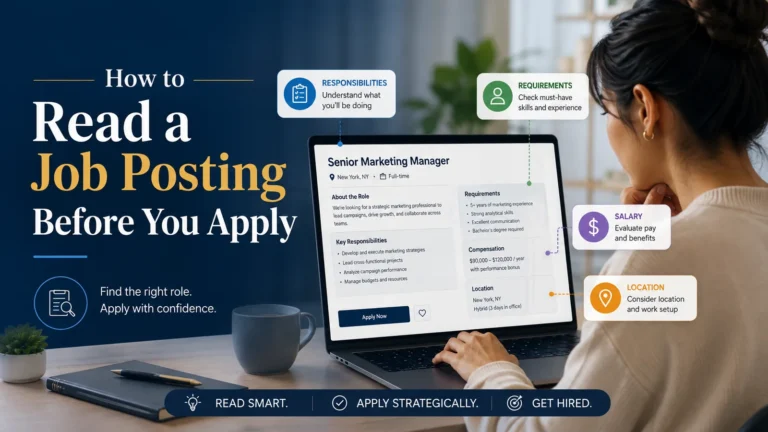
Print or copy the vacancy and highlight responsibilities, technical skills, behavioral capabilities, domain knowledge, language requirements, and measurable outcomes. For every major requirement, write one example from work, study, volunteering, or projects that proves something relevant.
If a requirement is a gap, do not hide it from yourself. Prepare an honest explanation of your current level and what you are doing to close it. Interviewers often evaluate self-awareness as well as existing capability.
Research the organization with a decision in mind
Learn what the organization does, who it serves, the products or services relevant to the role, recent public developments, and the broad context of the industry. Use official sources first, then reputable external sources for additional perspective.
Do not memorize the About page. Ask what the information means for the role. If the organization is expanding into a new market, how might that affect the team? If the product is regulated, what kinds of quality or compliance questions could arise? Research becomes useful when it helps you ask better questions.
Prepare a clear introduction
The “Tell me about yourself” answer should connect your recent background to the role. A useful structure is present, relevant past, and next direction: what you do now, which experiences built the relevant capability, and why this opportunity is a logical next step.
Keep the first version around one to two minutes. Prepare shorter and longer versions because interview styles differ. Avoid retelling your entire life or reading your resume chronologically.
Build a story bank for behavioral questions
Instead of memorizing answers to every possible question, prepare six to eight versatile stories: a difficult problem, a mistake, conflict, leadership or initiative, tight deadline, learning experience, successful result, and decision with incomplete information. Use the STAR logic—situation, task, action, result—without sounding mechanical.
Focus most of the answer on your action. If the result was mixed, explain what changed afterward. Honest learning stories can be stronger than stories that pretend every project ended perfectly.
Prepare for technical or role-specific assessment
Technical interviews vary widely. Study the actual skill level implied by the vacancy and ask the recruiter what format to expect when appropriate. You may face a case, coding task, portfolio review, writing exercise, presentation, role-play, spreadsheet test, design critique, or domain discussion.
Practice under similar constraints. If the interview includes a presentation, rehearse aloud with a timer. If it includes coding, solve problems without autocomplete. If it includes a case, practice clarifying the objective and explaining assumptions before calculating.
Practice aloud, not only in your head
Answers that feel clear internally can become too long when spoken. Record yourself answering five common questions and listen once for structure, once for filler words, and once for evidence. Do not aim to eliminate every pause; thoughtful silence is better than rushing.
Ask a friend to interrupt with follow-up questions. Real interviews are interactive, and the ability to adapt matters more than repeating a polished monologue.
Prepare questions for the interviewer
Good questions help you evaluate the opportunity and demonstrate that you understand the role. Ask about priorities for the first months, how success is measured, team interfaces, current challenges, decision authority, learning expectations, manager style, or the next stage of the process.
Avoid asking questions whose answers are easily visible on the public website unless you are asking for deeper context. Compensation and benefits are legitimate topics, but timing and the person you ask may depend on the stage of the process.
Control interview-day logistics
For an in-person interview, confirm location, travel time, building access, parking or transport, contact person, and what you need to bring. Arrive with enough buffer to handle normal delays without arriving extremely early. For an online interview, test camera, microphone, internet, lighting, background, meeting link, screen sharing, and device power.
Keep your resume, vacancy, notes, portfolio links, and a blank page available. Notes should support memory, not become a script you read continuously.
Manage nerves through preparation and pacing
Interview anxiety does not mean you are unprepared or unsuitable. Reduce unnecessary uncertainty by practicing the opening minute, checking logistics, sleeping reasonably, and arriving with time to settle. During the interview, listen to the full question and take a brief pause before answering.
If you do not understand a question, ask for clarification. If you do not know an answer, explain what you do know and how you would find or solve the missing part instead of inventing information.
After the interview
Write down the questions you received, examples that worked, places where you became vague, and new information about the role. Send a short thank-you or follow-up message when appropriate, especially if the recruiter has given a communication channel and timeline.
Do not interpret every delay as rejection. Follow the stated timeline and send one reasonable follow-up when needed. Continue other applications until you have a confirmed offer that you intend to accept.
A 24-hour preparation checklist
- Read the vacancy again and mark the five most important requirements.
- Prepare evidence for each requirement.
- Review the organization and the team or product relevant to the role.
- Practice your introduction and six story-bank examples aloud.
- Prepare three to five questions for the interviewer.
- Test location or video-call logistics.
- Prepare clothes, documents, portfolio, and contact details.
- Sleep and leave enough time so logistics do not create additional stress.
Prepare for different interviewer perspectives
A recruiter may focus on motivation, availability, communication, and broad fit. A hiring manager may probe role judgment and results. A future teammate may test practical collaboration. A senior leader may care about priorities, risk, and impact. The same story can be adjusted in depth without changing the facts.
Practice identifying what the question is really trying to learn. Then select the most relevant evidence rather than giving the same prepared answer to every interviewer.
Practical conclusion
Prepare around the job requirements, not a list of generic interview questions. Build a small bank of truthful examples, practice speaking them clearly, research the organization, and remove logistical surprises. After each interview, record what you learned so the next one becomes easier.
How this page was prepared and when it is reviewed
Method: The article turns a career question into a practical method, gives concrete examples, and preserves source links for facts that can change.
Review trigger: Run the diagnosis again after one controlled change instead of changing several variables at once.
For changing information, check the original source before making an important decision.
Sources and verification
Last checked: 2026-08-19- Official sourceApplying for Jobs through Jadarat – HRDFhrdf.org.sa
- Official sourceCareer Guidance (Subol) – HRDFhrdf.org.sa
- Official sourceCareer Path Service – HRDFhrdf.org.sa
Sources support the framework and reference data; professional application varies by organization, situation, and date.

The Mahana editorial team reviews career articles, guides, links, and time-sensitive information under the published editorial policy.
Editorial and verification method