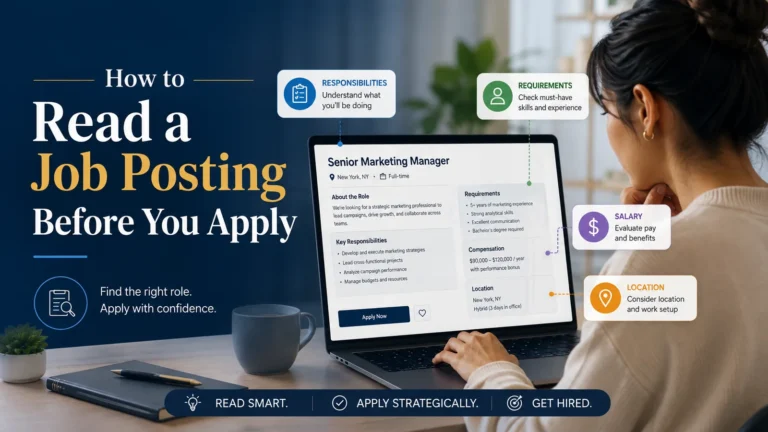

“Why should we hire you?” is one of the most direct questions in a job interview. It can feel uncomfortable because it appears to ask you to prove that you are better than every other candidate. That is not the most useful way to understand it. The interviewer is usually testing whether you understand the role, can identify your relevant strengths, and can connect those strengths to credible evidence.
A strong answer does not attack other applicants and does not rely on adjectives such as “hardworking,” “passionate,” or “fast learner.” It gives the employer a clear hiring logic: this is what the role needs, this is the evidence that I can handle those needs, and this is how I expect to contribute while continuing to learn.
What the interviewer is really asking
The employer already has your resume. The question is designed to see whether you can prioritize information. Can you identify the two or three parts of your background that matter most to this vacancy? Can you explain value without exaggeration? Can you speak about your experience in the employer’s language rather than reciting your biography?
The interviewer may also be checking self-awareness. A candidate who claims to be perfect can sound unrealistic. A candidate who cannot name any strength can sound unprepared. The goal is a balanced answer supported by evidence.
Start with the job, not with yourself
Before preparing the answer, read the job description again. Highlight repeated responsibilities, required tools, customer or team context, and the results the role is expected to support. Then rank the requirements by importance.
If the role repeatedly mentions customer communication, problem resolution, and accurate documentation, those themes should shape your answer. If the role emphasizes analysis, reporting, and stakeholder presentations, a different set of evidence should appear.
This approach prevents a common mistake: giving the same answer to every company. The facts about your background remain true, but the selection of evidence changes depending on what the employer needs.
Replace adjectives with proof
“I am a hard worker” is difficult to evaluate. “During my internship, I managed a weekly reporting task, corrected data errors before submission, and consistently delivered on the agreed deadline” is stronger because it gives the interviewer something concrete.
Evidence does not have to come from full-time employment. A new graduate can use academic projects, internships, volunteering, student activities, freelance work, or serious personal projects. The key is to choose an example that demonstrates the same capability the job requires.
A practical three-part structure
- Show that you understand the role. Mention one or two priorities you noticed.
- Connect those priorities to evidence. Give a short example that proves your capability.
- Explain your likely contribution. Describe how the experience can help you add value while remaining realistic about what you still need to learn.
A simple template is: “From what I understand, this role needs strong capability in X and Y. In my recent experience, I worked on Z, where I used the same skills and learned how to handle A. I believe that background would help me contribute to B, and I am also ready to keep developing C as I learn the team’s process.”
Example for a new graduate
“I think I would be a strong fit because the role combines analysis and communication, which are two areas I have practiced during my university projects and internship. In my final project, I organized the data, built a simple analysis, and presented the findings to a mixed audience. During my internship, I also learned how important accuracy and follow-up are in a real team. I am early in my career, so I know I still have a lot to learn, but I can bring a solid foundation, careful work, and the willingness to take feedback quickly.”
Example for customer service
“The role needs someone who can listen carefully, solve customer issues without losing accuracy, and document what happened. In my previous role, I handled customer requests across several channels and learned to separate the customer’s emotion from the actual problem that needed to be solved. I also made sure the case notes were clear enough for another colleague to continue if needed. I think that combination of communication and process discipline would help me contribute here.”
Example for a candidate changing careers
“I am moving from operations into project coordination, so I would not claim that my background is identical to someone who has held this title for years. What I do bring is experience organizing deadlines, following up with several stakeholders, documenting issues, and keeping work moving when priorities change. I have also completed focused training in project planning and used it in a small portfolio project. That gives me a realistic foundation for this role and a clear idea of the areas I need to deepen.”
What if another candidate has more experience?
You do not know the other candidates, so avoid comparing yourself with imaginary competitors. Instead, explain your own advantage. That could be recent technical training, language ability, knowledge of a particular customer group, a strong portfolio, exposure to the industry, or a demonstrated ability to learn quickly.
Experience is important, but hiring decisions are not based on years alone. Relevance, judgment, communication, salary fit, motivation, and team needs also matter. Your task is to make your evidence easy to understand.
Common weak answers
- “Because I need the job.” Your need is understandable, but it does not explain the employer’s benefit.
- “Because I am the best candidate.” You usually do not have enough information to make that claim.
- “I am hardworking, motivated, and a fast learner.” These are generic unless you support them with evidence.
- “You should hire me because of my degree.” Education can be relevant, but the employer still needs to understand how it translates into performance.
- A five-minute speech. If the main point appears late, the answer loses impact.
How long should the answer be?
There is no universal number of seconds, but most candidates benefit from a focused response of roughly one minute, followed by more detail if the interviewer asks. The answer should feel complete without becoming a monologue.
Practice the structure, not every word. A memorized script can collapse when the interviewer interrupts or changes the wording. Flexible preparation sounds more natural and helps you respond to follow-up questions.
Prepare two evidence examples before the interview
Choose two central requirements from the job description. For each one, prepare a short example using a clear situation, your responsibility, what you did, and what happened. You may only use one example in the final answer, but having two gives you flexibility.
If the role is technical, be ready to explain your reasoning, not only the final result. If the role is customer-facing, be ready to discuss how you handled communication, priorities, or conflict. If the role is entry-level, emphasize learning, reliability, and the quality of your practice.
Final checklist
- I can name the employer’s two most important needs.
- I have evidence for at least one of those needs.
- I removed generic adjectives that I cannot prove.
- I do not compare myself with unknown candidates.
- I explain contribution without promising unrealistic results.
- I can deliver the answer naturally in about a minute.
The bottom line
The best answer to “Why should we hire you?” is not a sales slogan. It is a concise argument supported by evidence. Understand the role, select the most relevant parts of your experience, and explain how those experiences can help you contribute. Confidence comes from preparation and proof, not from claiming to be perfect.
How this page was prepared and when it is reviewed
Method: The article turns a career question into a practical method, gives concrete examples, and preserves source links for facts that can change.
Review trigger: Review the wording before use and adapt it to the actual person and context.
For changing information, check the original source before making an important decision.
Sources and verification
Last checked: 2026-08-19- Official sourceApplying for Jobs through Jadarat – HRDFhrdf.org.sa
- Official sourceCareer Guidance (Subol) – HRDFhrdf.org.sa
- Official sourceCareer Path Service – HRDFhrdf.org.sa
Sources support the framework and reference data; professional application varies by organization, situation, and date.

The Mahana editorial team reviews career articles, guides, links, and time-sensitive information under the published editorial policy.
Editorial and verification method