Write Clear Professional Emails
Practical steps to make the purpose, decision, and requested action obvious on the first read. Final output: a precise subject line and a short message with explicit next steps.

Start with clear wording, then adapt it to the person and context rather than memorising a rigid script.
For: Job seekers and working professionalsA precise subject line and a short message with explicit next steps
Make the purpose, decision, and requested action obvious on the first read.
Use the precise subject line and a short message with explicit next steps as an updateable decision record, not a fixed template.
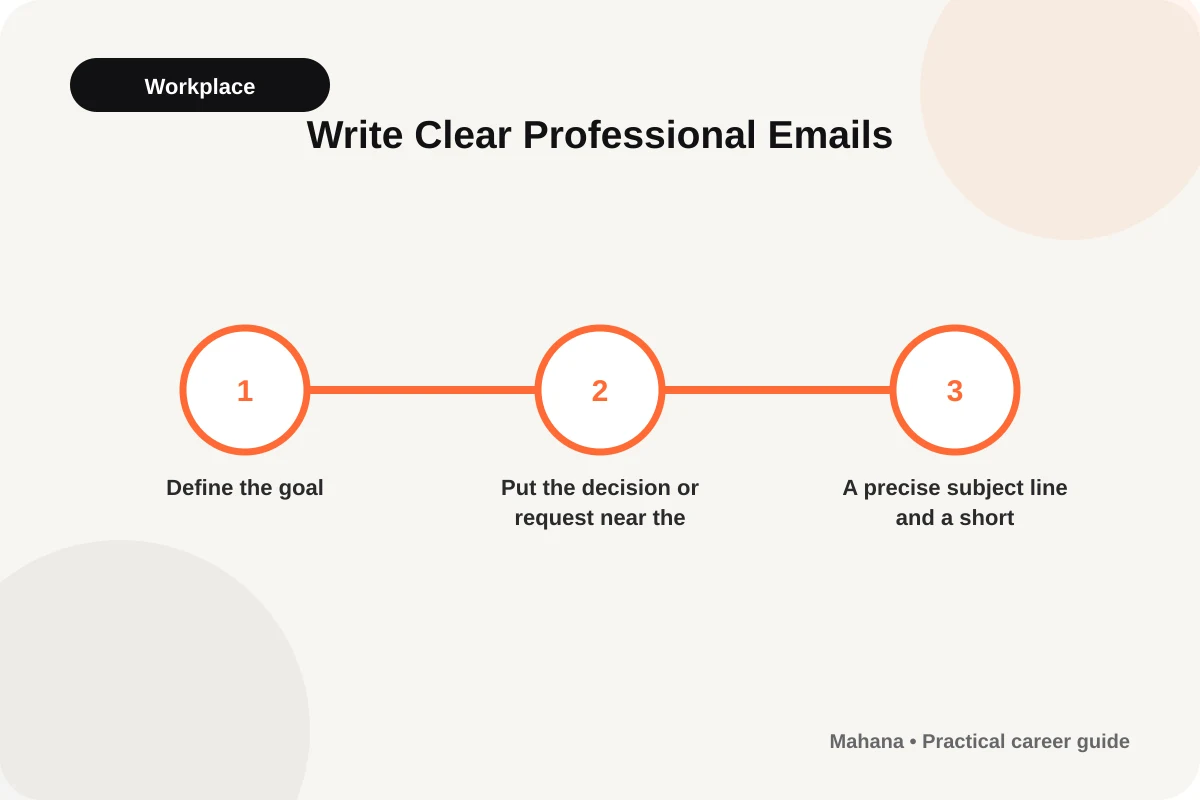
This guide helps you make the purpose, decision, and requested action obvious on the first read through one defined output: A precise subject line and a short message with explicit next steps. In “Write Clear Professional Emails,” do not treat the steps as separate tips; each checkpoint should change the precise subject line and a short message with explicit next steps and leave reviewable evidence.
When this guide is useful
Before applying “Write Clear Professional Emails,” account for this context: Make ownership, timing, decision status, and the next action explicit. Colleagues should not need to reconstruct the context from several messages.
Use it when you need a decision or document that another person can understand. Before starting, write the current situation, the required result, and the highest-impact constraint so the precise subject line and a short message with explicit next steps reflects your case rather than a generic template.
Build the precise subject line and a short message with explicit next steps through clear checkpoints
Put the decision or request near the first line
Begin “Put the decision or request near the first line” with this rule: write the first version for the actual reader and purpose; keep the main point near the opening, then support it with only the evidence needed for the next decision. Connect this result to the next checkpoint in the precise subject line and a short message with explicit next steps so the action remains traceable to its evidence.
Use a subject that names the topic and deadline when relevant
The required result from “Use a subject that names the topic and deadline when relevant” is concrete: use plain language and make the subject, contribution, and requested action visible; remove sentences that merely repeat the title or describe you with unsupported adjectives. Mark what is complete and what remains open in the precise subject line and a short message with explicit next steps, including the information needed to close it.
Give only the context needed for the decision
The “Give only the context needed for the decision” checkpoint addresses one practical issue: keep the wording specific to the real person and situation; a short message with a clear purpose is stronger than a generic script with excessive explanation. Date the result in the precise subject line and a short message with explicit next steps so current evidence is not confused with an earlier version.
State the owner and due date for every action
Apply “State the owner and due date for every action” to the real case rather than only the example: draft from facts before polishing style; a concise, specific version is easier to test against the role, recipient, or document requirement. Test this checkpoint on one real case, then record the necessary adjustment in the precise subject line and a short message with explicit next steps.
Check names, attachments, links, and recipients before sending
Turn “Check names, attachments, links, and recipients before sending” into reviewable action: collect only enough evidence to answer the current question; keep links or screenshots so the conclusion can be reviewed instead of reconstructed from memory. Add an owner and review date to the precise subject line and a short message with explicit next steps when progress depends on another person or missing information.
Worked example: from first action to review
In a real case related to “Write Clear Professional Emails,” use a current, low-risk situation rather than a hypothetical case. Begin with “Put the decision or request near the first line”, communicate the information or decision, and then complete “Check names, attachments, links, and recipients before sending”. The precise subject line and a short message with explicit next steps should retain the owner, timing, and agreed next action.
Mistakes that weaken the result
- Moving to “Use a subject that names the topic and deadline when relevant” before retaining the result of “Put the decision or request near the first line”, leaving the decision dependent on a hidden assumption.
- Turning the precise subject line and a short message with explicit next steps into a long note without a completion condition, owner, or review point.
- Completing “Check names, attachments, links, and recipients before sending” once and then failing to update the output when new evidence appears.
Final check before use
- I can show the result of “Put the decision or request near the first line” and the evidence used to begin.
- Facts, estimates, and open questions are separated inside the precise subject line and a short message with explicit next steps.
- Every action created by “Give only the context needed for the decision” has an owner, date, or clear closing condition.
- I completed “Check names, attachments, links, and recipients before sending” and recorded when the decision should be reviewed again.
When “Write Clear Professional Emails” does not apply
For “Write Clear Professional Emails”, this is practical guidance, not a legal or regulatory determination. If the authority, contract, or evidence behind the decision changes, pause the consequential action, verify the official source, and record the change in A precise subject line and a short message with explicit next steps.
Do not use the “Write Clear Professional Emails” example to hide a capability gap or present regulated practice without supervision. For “Write Clear Professional Emails”, start with a contained scope, obtain an appropriate review, and keep the boundary of what this guide can prove explicit.
Frequently asked questions
How can I start applying “Write Clear Professional Emails” today?
Apply “Put the decision or request near the first line” to one real case, then record the result and evidence in the precise subject line and a short message with explicit next steps. Do not move to “Check names, attachments, links, and recipients before sending” until you can name what changed after the first checkpoint.
What shows that the precise subject line and a short message with explicit next steps is complete?
It is ready for review when it identifies the decision, owner, timing, and anything that requires confirmation or escalation.
When should I pause or seek help with “Write Clear Professional Emails”?
Do not use this guide in place of company policy, a grievance channel, or qualified advice when risk or a dispute is involved.
Sources and use limits
These links support changing claims. Check the latest official text before making a binding decision.
Package source check: 2026-10-07.
Questions about this guide
What is the first step in Write Clear Professional Emails?
Begin with “Put the decision or request near the first line” and record the current situation and evidence in the precise subject line and a short message with explicit next steps.
How do I know the precise subject line and a short message with explicit next steps is usable?
Another person should be able to understand the decision or document, identify the source, and see the next action without a long verbal explanation.
When should I review it again?
Review it when material information changes or after the final step is used, and record the change in the precise subject line and a short message with explicit next steps.
Start with one checkpoint, keep every decision visible in the precise subject line and a short message with explicit next steps, and review the result before expanding the approach.
View all guidesHow this page was prepared and when it is reviewed
Method: The guide turns “Make the purpose, decision, and requested action obvious on the first read.” into checkpoints tied to one output, the precise subject line and a short message with explicit next steps, while separating facts from assumptions and linking changing information to its sources.
Review trigger: Review the precise subject line and a short message with explicit next steps when material information changes or after its first real use; record the change, its reason, and the result observed afterwards.
For changing information, check the original source before making an important decision.
Sources and verification
Last checked: 2026-08-20Sources support the framework and reference data; professional application varies by organization, situation, and date.

The Mahana editorial team reviews career articles, guides, links, and time-sensitive information under the published editorial policy.
Editorial and verification method