
Explain a Career Gap Clearly
Practical steps to give a brief, factual explanation of a career gap and move the conversation back to current readiness. Final output: a three-sentence interview answer you can deliver naturally.
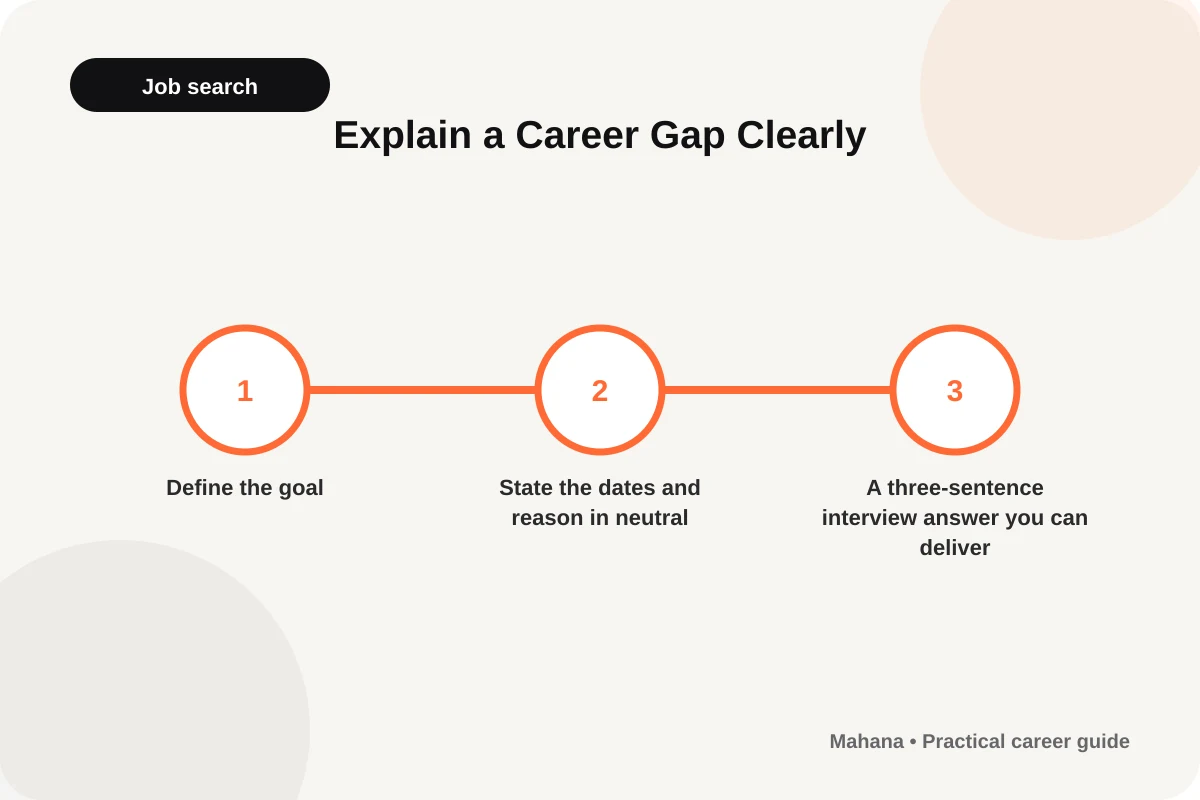
Complete the prompts and leave with an output you can use and review.
For: Job seekers and working professionalsA three-sentence interview answer you can deliver naturally
Give a brief, factual explanation of a career gap and move the conversation back to current readiness.
Use the three-sentence interview answer you can deliver naturally as an updateable decision record, not a fixed template.
This guide helps you give a brief, factual explanation of a career gap and move the conversation back to current readiness through one defined output: A three-sentence interview answer you can deliver naturally. In “Explain a Career Gap Clearly,” do not treat the steps as separate tips; each checkpoint should change the three-sentence interview answer you can deliver naturally and leave reviewable evidence.
When this guide is useful
For “Explain a Career Gap Clearly,” use current vacancies and your own response data as the evidence base; activity only matters when it improves targeting, applications, or follow-up.
Use it when you need a decision or document that another person can understand. Before starting, write the current situation, the required result, and the highest-impact constraint so the three-sentence interview answer you can deliver naturally reflects your case rather than a generic template.
Build the three-sentence interview answer you can deliver naturally through clear checkpoints
State the dates and reason in neutral language
For the “State the dates and reason in neutral language” checkpoint in “Explain a Career Gap Clearly,” make every sentence perform a job: context, evidence, decision, or action; if it does none of these, shorten or remove it. Use the three-sentence interview answer you can deliver naturally to retain the evidence and assumption behind this step, then update it if the information changes.
Mention how you maintained or developed relevant capability
For the “Mention how you maintained or developed relevant capability” checkpoint in “Explain a Career Gap Clearly,” draft from facts before polishing style; a concise, specific version is easier to test against the role, recipient, or document requirement. This checkpoint is complete when another person can review what you added to the three-sentence interview answer you can deliver naturally and understand the reason.
Connect your return to the role you are targeting
For the “Connect your return to the role you are targeting” checkpoint in “Explain a Career Gap Clearly,” choose the smallest set that can still produce the intended result; a focused shortlist makes tailoring, practice, and review more accurate. Connect this result to the next checkpoint in the three-sentence interview answer you can deliver naturally so the action remains traceable to its evidence.
Prepare one recent proof of readiness
For the “Prepare one recent proof of readiness” checkpoint in “Explain a Career Gap Clearly,” write the first version for the actual reader and purpose; keep the main point near the opening, then support it with only the evidence needed for the next decision. Mark what is complete and what remains open in the three-sentence interview answer you can deliver naturally, including the information needed to close it.
Answer briefly, then shift to the value you can bring
For the “Answer briefly, then shift to the value you can bring” checkpoint in “Explain a Career Gap Clearly,” use a time box and an observable success condition; the review should identify the next practice target, not merely whether the attempt felt comfortable. Record the result inside the three-sentence interview answer you can deliver naturally so the decision and any follow-up remain visible.
Worked example: from first action to review
For the “Explain a Career Gap Clearly” guide, apply the guide to five real opportunities during one week. Begin with “State the dates and reason in neutral language” and record why each option was retained or removed in the three-sentence interview answer you can deliver naturally. After results appear, complete “Answer briefly, then shift to the value you can bring” and compare what changed in targeting or follow-up quality.
Mistakes that weaken the result
- Moving to “Mention how you maintained or developed relevant capability” before retaining the result of “State the dates and reason in neutral language”, leaving the decision dependent on a hidden assumption.
- Turning the three-sentence interview answer you can deliver naturally into a long note without a completion condition, owner, or review point.
- Completing “Answer briefly, then shift to the value you can bring” once and then failing to update the output when new evidence appears.
Final check before use
- I can show the result of “State the dates and reason in neutral language” and the evidence used to begin.
- The three-sentence interview answer you can deliver naturally distinguishes facts, estimates, and open questions.
- Every action created by “Connect your return to the role you are targeting” has an owner, date, or clear closing condition.
- I completed “Answer briefly, then shift to the value you can bring” and recorded when the decision should be reviewed again.
Sources and limits
Check the steps against the facts of your case and the date of each source. This page refers to Career guidance — HRDF, Job applications — Jadarat, but changing rules or binding decisions require the latest official source.
Package structure and source check: 2026-08-20.
Questions about this guide
What is the first step in Explain a Career Gap Clearly?
Begin with “State the dates and reason in neutral language” and record the current situation and evidence in the three-sentence interview answer you can deliver naturally.
How do I know the three-sentence interview answer you can deliver naturally is usable?
Another person should be able to understand the decision or document, identify the source, and see the next action without a long verbal explanation.
When should I review it again?
Review it when material information changes or after the final step is used, and record the change in the three-sentence interview answer you can deliver naturally.
Start with one checkpoint, keep every decision visible in the three-sentence interview answer you can deliver naturally, and review the result before expanding the approach.
View all guidesHow this page was prepared and when it is reviewed
Method: The guide turns “Give a brief, factual explanation of a career gap and move the conversation back to current readiness.” into checkpoints tied to one output, the three-sentence interview answer you can deliver naturally, while separating facts from assumptions and linking changing information to its sources.
Review trigger: Review the three-sentence interview answer you can deliver naturally when material information changes or after its first real use; record the change, its reason, and the result observed afterwards.
For changing information, check the original source before making an important decision.
Sources and verification
Last checked: 2026-08-20- Official sourceCareer guidance — HRDFhrdf.org.sa
- Official sourceJob applications — Jadarathrdf.org.sa
Sources support the framework and reference data; professional application varies by organization, situation, and date.

The Mahana editorial team reviews career articles, guides, links, and time-sensitive information under the published editorial policy.
Editorial and verification method